
Reviewed · BUCKINGHAM PALACE & ROYAL TOURS
Buckingham Palace, St James Palace & Tea at Kensington Palace
London’s royal quarter makes a fine stage for a walking tour, but the best part here is the finish: afternoon tea at Kensington Palace, with finger sandwiches, Welsh scones, clotted cream, jam, and seasonal cakes. Along the way, guides such as Simon, David, and Tom connect grand façades with the clubs, courtiers, and odd royal habits behind them.
I like the small group size, usually four to six people and never more than 10. I also like the clever route, which links Green Park, St James’s, Buckingham Palace, Wellington Arch, and Kensington Palace in one outing. The main caution is simple: this is a walking tour with several short stops, not a full palace-interior visit unless you select that option and allow extra time for tea afterward.
In This Review
- Key points
- A royal walk that saves you from a palace-only day
- Green Park and the quiet side of St James’s
- Spencer House and the grand homes beside the palaces
- The Mall, Clarence House, and St James’s Palace
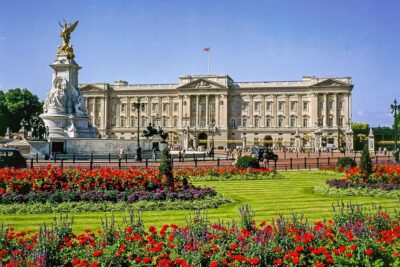
- Buckingham Palace from the outside
- Wellington Arch, the Bomber Command Memorial, and Apsley House
- Royal Albert Hall and the Albert Memorial
- Kensington Palace and tea at the Orangery
- What the $173.45 price really buys you
- Who will enjoy this royal route most?
- Should you book Buckingham Palace, St James’s Palace and tea?
- FAQ
- How long does the experience last?
- Where does the tour begin and end?
- Are palace interiors included?
- Is transportation included?
- What food is served at afternoon tea?
- Can dietary requirements be accommodated?
Key points
- Tea at Kensington Palace: Finish at the Orangery with sandwiches, scones, clotted cream, jam, and cakes at a private table.
- Small groups: The maximum is 10, with the usual group closer to four to six people.
- Three royal residences: See St James’s Palace, Buckingham Palace, and Kensington Palace in one London outing.
- More than palace gates: The route adds Spencer House, Clarence House, Apsley House, Royal Albert Hall, and the Albert Memorial.
- Walking plus public transport: Bring a contactless card or Oyster card for the £1.75 bus fare.
- Interior access is optional: The walking portion does not include palace entry unless you select entrance to the State Rooms at checkout.
A royal walk that saves you from a palace-only day
This experience begins at Green Park Underground station and heads through London’s royal quarter. The opening stretch is not about rushing to Buckingham Palace for a quick photograph. Your guide takes you through quieter corners and side passages, then explains how St James’s became a district for aristocrats, politicians, clubs, taverns, and old chocolate houses.
That approach gives you useful context. A palace is easier to understand when you know who lived nearby, where political society met, and why certain streets still feel more formal than the rest of London. The guide-led format also lets you ask questions as you go, something you lose when simply following a map between famous buildings.
The tour is advertised at about two hours, though the afternoon tea is the main event at the end and should be treated as additional sitting time. The sightseeing stops are brief, often five or 10 minutes each, so this is a highlights walk rather than a slow architectural study.
More royal London visits:
- Buckingham Palace: The State Rooms Entrance Ticket
★ 4.6 · 7,395 reviews - London: Buckingham Palace & Changing of the Guard Experience
★ 4.3 · 2,971 reviews - London: Changing of The Guard Tour
★ 4.8 · 2,510 reviews
Green Park and the quiet side of St James’s
Green Park is the meeting point, near Green Park Underground station at Piccadilly. The park is a useful place to begin because it puts you close to Buckingham Palace while giving the tour room to start with London’s royal geography.
You then move into St James’s. This was the aristocratic heart of London, where the landed elite and political classes met in clubs and taverns during the seventeenth century. The appeal here lies in the smaller streets. They offer a break from the broad ceremonial avenues and help you picture the social world that grew around the palace.
The time allocation is short, but a good guide can make a short street walk worthwhile. Simon has been especially praised for explaining the past clearly to mixed-age families, while David is noted for linking landmarks with the larger story of royal life. That matters if your group includes children or people who do not usually read plaques and architectural notes.
Spencer House and the grand homes beside the palaces
Spencer House takes only about five minutes, but it adds an important contrast. Built between 1756 and 1766 for John, first Earl Spencer, it is one of London’s finest surviving eighteenth-century town houses. It was also connected to Diana, Princess of Wales, who descended from the Spencer family.
You will view it from outside on the walking portion. That is worth knowing before you book, since the tour’s language about palaces and royal homes can sound as if you will enter each one. The standard route is mainly exterior sightseeing, storytelling, and neighborhood history.
The brief stop helps show that royal London was not made up only of monarchs. Aristocratic families had their own grand houses, influence, and social networks. Spencer House gives you a glimpse of that world without taking you far from the royal route.
The Mall, Clarence House, and St James’s Palace
The Mall supplies the ceremonial side of the experience. It leads toward Buckingham Palace and is one of the clearest places to see how London presents monarchy in public. Your guide then points out Clarence House, built between 1825 and 1827 for the Duke of Clarence, later King William IV.
Clarence House has a particularly human detail in its story. William IV preferred it to the older St James’s Palace because he found the Tudor building cramped. That small fact does more than list a date. It reminds you that royal residences were homes with practical annoyances, not just symbols.
St James’s Palace remains the official London royal palace, but it is not regularly open for general visits. The public can attend Sunday services at the Chapel Royal and the Queen’s Chapel. On this tour, expect to see the exterior and hear its story rather than walk through its rooms.
The repeated references to St James’s neighborhood and St James’s Palace reflect two related but different things: the district around the palace and the palace itself. Your guide should help keep those pieces clear. This is one place where a live explanation is more useful than a quick independent stroll.
Something completely different for your London days:
- London: The London Eye Entry Ticket
★ 4.6 · 35,875 reviews - From London: Harry Potter Warner Bros Studio Tour
★ 4.7 · 26,588 reviews - London: Westminster to Greenwich River Thames Cruise
★ 4.5 · 22,836 reviews - Magical London: Harry Potter Guided Walking Tour
★ 4.7 · 22,044 reviews
Buckingham Palace from the outside
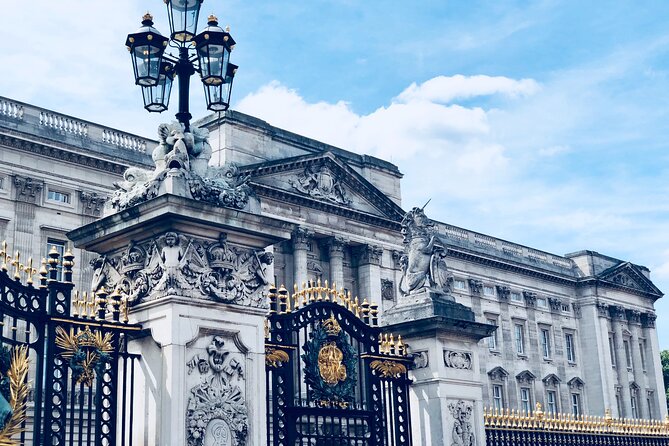
Buckingham Palace receives only a short stop on the walking route. You will get the setting and the story of the site, which began as part of the Manor of Ebury, a marshy area watered by the River Tyburn. That river still flows beneath the palace courtyard and south wing.
The palace’s early ownership passed through figures including Edward the Confessor and William the Conqueror before the land went to Westminster Abbey’s monks. Those medieval details can seem far removed from the familiar palace gates, but they explain how a royal site developed over centuries.
Do not book this experience expecting a long visit inside Buckingham Palace as part of the basic walk. You see the palace from the outside unless entrance has been selected at checkout. The State Rooms option changes the value and the pace, so check exactly what you are buying before paying.
If your main goal is the Changing of the Guard, ask about timing before booking. One person wished the tour had included part of the ceremony, and the published route does not promise that it will. The tour is built around a broader royal walk, not around guaranteed guard-changing access.
Wellington Arch, the Bomber Command Memorial, and Apsley House
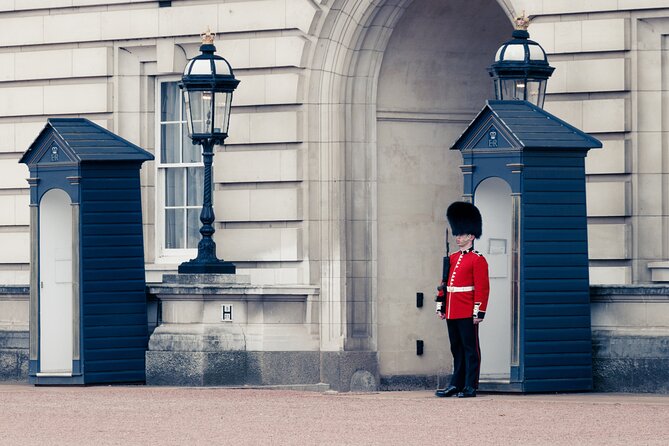
After Buckingham Palace, the route crosses toward Wellington Arch. Decimus Burton designed the arch in 1828, and its four-horse chariot with a figure of Peace was added in 1912. The central passage was once reserved for royalty.
This stop gives you a useful view of the old boundary between royal ceremony, military power, and the city’s major routes. It is also a natural place to notice that London’s monuments often carry more than one political message.
Nearby, the Bomber Command Memorial commemorates the 55,573 aircrew of RAF Bomber Command who died during Second World War missions. The memorial also recognizes civilians killed during raids and the allied personnel from Britain, Canada, Australia, New Zealand, Czechoslovakia, Poland, and other countries.
The memorial changes the mood. Until this point, the walk centers on court life and grand houses. Here, the focus turns to wartime loss and national memory. I value that change because it keeps the route from becoming a procession of royal names without wider human context.
Apsley House adds another layer. Robert Adam built the original red-brick house between 1771 and 1778 for Lord Apsley, the Lord Chancellor. Some Adam interiors survive, including the Piccadilly Drawing Room and the Portico Room, which sits behind the large Corinthian portico added by the Duke of Wellington.
Again, the walking tour views these places from outside. If you want to inspect interiors, you should check the separate entry choices rather than assume they are included.
Royal Albert Hall and the Albert Memorial
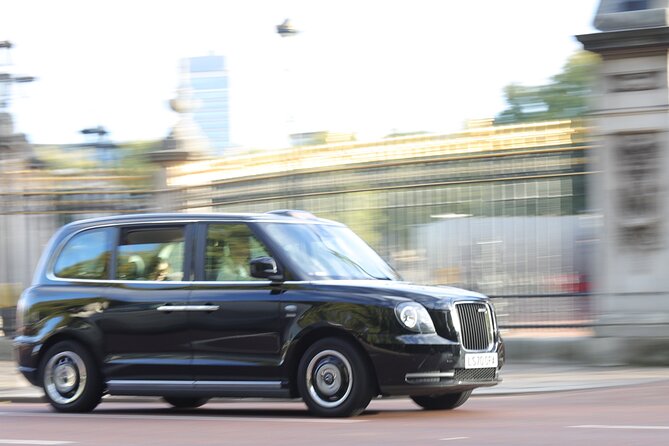
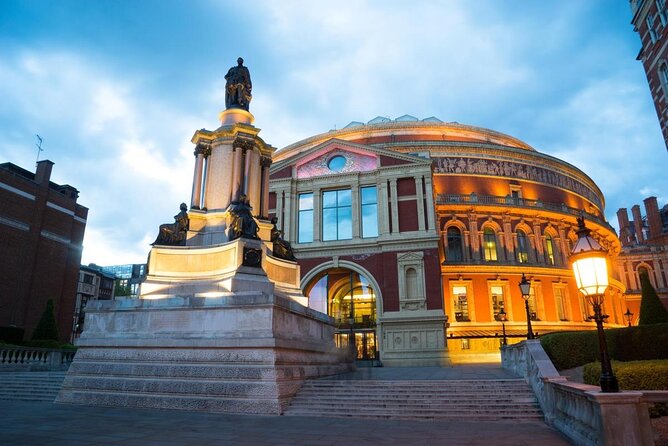
The route continues toward South Kensington and Royal Albert Hall. Opened by Queen Victoria in 1871, the concert hall seats 5,272 people and has hosted leading performers from many types of music and performance.
A five-minute stop cannot cover the hall’s full story, but it gives you a strong sense of the Victorian ambition behind the area. Royal Albert Hall is not a royal residence, yet it belongs in this tour because it reflects the public culture and imperial confidence associated with Queen Victoria’s era.
The Albert Memorial in Kensington Gardens is one of London’s most ornate monuments. Prince Albert died of typhoid in 1861, and the memorial was built to honor him. Its elaborate design makes it an effective final landmark before the tea, though you may want extra time later if you care about sculpture and detail.
The walking route covers a lot of ground between central London and Kensington. One useful piece of advice is to wear comfortable shoes and keep your pace steady. The walk is not described as highly athletic, but it is still a real city walk, and the many short stops can make the distance feel longer than the timetable suggests.
Kensington Palace and tea at the Orangery
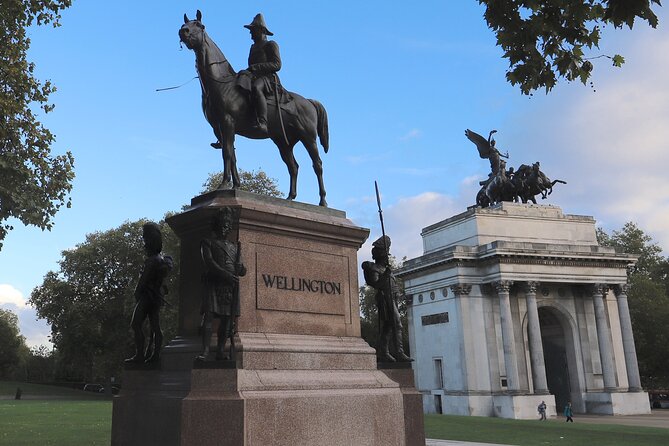
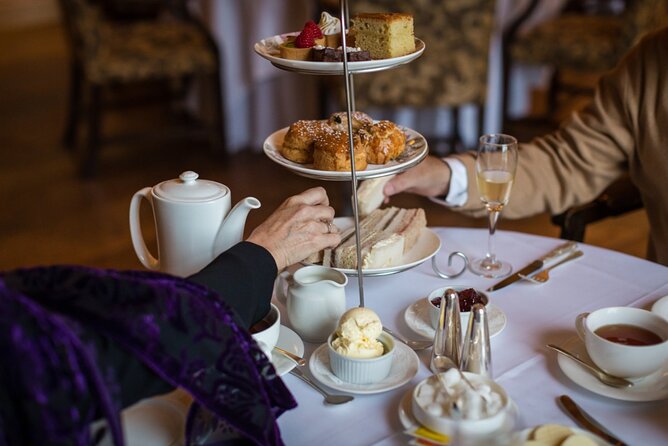
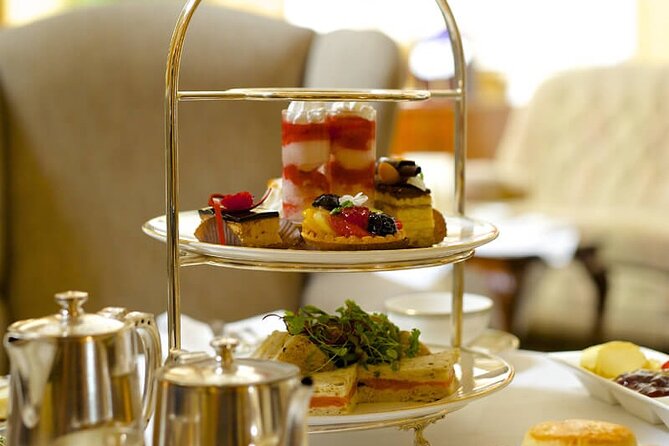
Kensington Palace is the destination, and the tour ends at the Orangery, where a private table is arranged for afternoon tea. The food follows a familiar British pattern: delicate finger sandwiches, Welsh scones served with clotted cream and strawberry jam, and a selection of seasonal cakes.
The sandwich selection changes with the season. Gluten-free, vegetarian, vegan, and halal choices are available with advance notice, which is important because these needs must be requested ahead of time. A child’s tea is typically intended for children 11 and younger.
The tour also includes an explanation of tea drinking in England. That is a worthwhile touch because afternoon tea has its own customs and vocabulary. The experience is not simply a plate of cakes added to a palace walk. You get some cultural context for why the meal matters and how it became part of British social life.
The setting is the main draw. Tea is held at Kensington Palace’s Orangery, rather than at an unrelated café after the walk. One booking option may include palace State Rooms, but the basic walking tour and tea do not automatically grant palace entry. Check the checkout details carefully.
Some tea services use china associated with Princess Diana, an especially memorable detail when available. The supplied information does not establish that this is guaranteed for every date, so treat it as a possible feature rather than a promise.
You can buy alcoholic drinks during tea, but they are not included. The meal itself includes sandwiches, scones, cream, jam, and cakes. If you want a full meal, the food is substantial for an afternoon sitting, though it is still afternoon tea rather than lunch or dinner.
What the $173.45 price really buys you
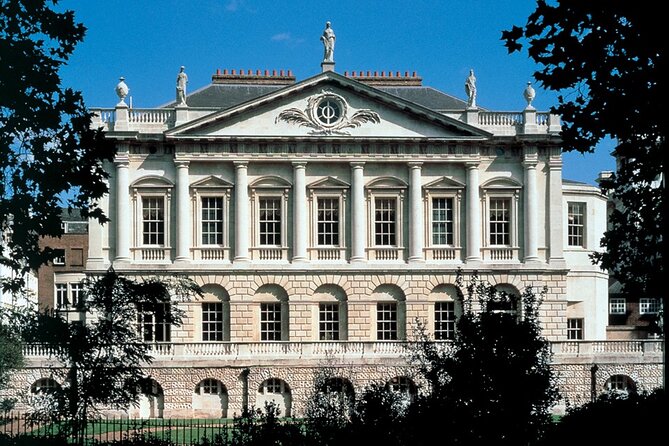
At $173.45 per person, this is not a budget walking tour. The value depends on how much you want handled for you. You are paying for a small group, a guide-led route through several royal districts, a private table, and the afternoon tea at Kensington Palace.
The price looks stronger if you have limited time in London. In one organized outing, you cover St James’s Palace, Buckingham Palace, and Kensington Palace, along with Spencer House, Clarence House, Wellington Arch, Apsley House, Royal Albert Hall, the Albert Memorial, and the Bomber Command Memorial.
It is less attractive if you mainly want to enter one palace and spend hours inside. The standard tour does not include palace entry, and the exterior stops are short. In that case, compare the cost with a direct palace admission and a separate tea booking.
The small group is a real part of the value. With a usual size of four to six and a maximum of 10, you have a better chance to hear the guide and ask questions than on a large city coach tour. The ability to choose a tour size at checkout also lets you weigh cost against personal attention.
Public transport is not bundled in. You should bring a contactless card or Oyster card for the £1.75 bus fare. There is no private transport, so include that small extra cost and expect to move through London like a resident rather than sit in a dedicated vehicle.
Who will enjoy this royal route most?
I would choose this for a first or second London visit when you want a strong overview of royal sites without planning several separate routes. It also suits families, especially when the guide can adjust the stories for different ages. Simon, David, and Tom are all named as guides associated with warm, engaging tours, but guide assignment is not something you should assume in advance.
The experience works well for people who like history in short, vivid pieces. You will hear about aristocratic clubs, royal homes, medieval land ownership, wartime sacrifice, Victorian memorials, and tea customs in a single afternoon.
It is also a good match if the tea matters as much as the sightseeing. The Orangery setting and private table give the final hour a sense of occasion, and the menu covers the familiar essentials without making the meal overly complicated.
I would hesitate if you dislike walking, need long visits at each landmark, or want guaranteed entry to all three palaces. The route offers a broad look from the outside, with optional State Rooms entry, rather than a detailed museum visit.
Free cancellation is available up to 24 hours before the start time for a full refund. Changes made inside that 24-hour window are not accepted, and the tour requires a minimum number of participants, so keep those terms in mind when arranging a tight schedule.
Should you book Buckingham Palace, St James’s Palace and tea?
Book it if you want a compact royal overview with a proper London tea at the end. The guide-led stories, small group, and range of landmarks give the walk more substance than a palace-gate photo stop, while the Orangery supplies the special setting.
Skip it if your priority is spending most of the day inside Buckingham Palace or Kensington Palace. For everyone else, especially families and short-stay visitors, the combination of royal streets, wartime and Victorian landmarks, and afternoon tea makes the $173.45 price easier to justify. Just confirm the State Rooms option, prepare for walking, and request dietary needs before the tour date.
FAQ
How long does the experience last?
The walking tour is approximately two hours. Afternoon tea takes place afterward at the Orangery at Kensington Palace, so allow additional time for the meal.
Where does the tour begin and end?
It begins at Green Park Underground Ltd on Piccadilly, London W1J 9DZ. It ends at Kensington Palace in Kensington Gardens, at the Orangery where the tea is hosted.
Are palace interiors included?
The walking tour does not include palace entry unless you select entrance to the State Rooms at checkout. St James’s Palace is not regularly open to visitors.
Is transportation included?
Private transport is not included. You should bring a contactless card or Oyster card for the £1.75 bus fare.
What food is served at afternoon tea?
The menu includes finger sandwiches, Welsh scones with clotted cream and strawberry jam, and a seasonal selection of cakes. Alcoholic drinks can be purchased separately.
Can dietary requirements be accommodated?
Gluten-free, vegetarian, vegan, and halal options are available with advance request. A child’s tea is typically for children aged 11 and younger.
Latest arrivals on the London list
- Heathrow Airport to London Arrival Transfer★ 4.5 · 50 reviews
- London Beatles Tour★ 5.0 · 50 reviews
- One Way Taxi Transfer from London to Gatwick Airport★ 5.0 · 51 reviews
- London: Hidden Baker Street Tube Station Tour★ 4.7 · 51 reviews
- City & Secrets: Explore London’s Hidden Gems★ 5.0 · 51 reviews
- London Christmas Lights Open-Top Bus Tour. 2025 Early Bird★ 3.6 · 51 reviews
- 4 hour London Private Tour, with your own Black Cab Tour Guide★ 5.0 · 51 reviews
- The Beatles Magical History Black Taxi Tour London★ 5.0 · 51 reviews
Buckingham Palace & Royal Tours, compared.
Buckingham Palace: The State Rooms Entrance Ticket
Read our review →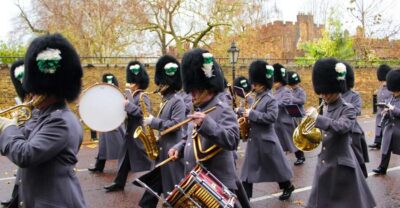
Buckingham Palace & Changing of the Guard Experience
Read our review →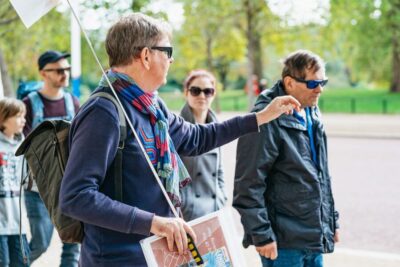
Westminster Abbey, Big Ben & Buckingham Guided Tour
Read our review →
Changing of the Guard Guided Walking Tour in London
Read our review →
Buckingham Palace: The Royal Mews Entrance Ticket
Read our review →
Buckingham Palace Entrance Ticket & Changing of the Guard Tour
Read our review →Browse the lists this tour appears in