
Reviewed · HISTORICAL TOURS
History of London Photography Tour
London’s financial district can look like a canyon of office blocks until someone shows you the details. This two-hour walking tour turns churches, banks, statues, bridges, and brick power stations into photography subjects, with a professional guide helping you find better angles and use your camera with more purpose.
I like the route for two clear reasons. First, it connects major sights with less obvious City of London corners, so you get both familiar landmarks and streets you might otherwise pass without a glance. Second, the guide works with mixed ability levels, from people refreshing their SLR skills to those still learning basic settings.
The main thing to consider is the pace. You cover ten stops in about two hours, ending across the river at Tate Modern. That gives you a broad taste of central London photography, but not a long, leisurely session at every location. The tour also needs good weather and requires a camera or camera phone to be worthwhile.
In This Review
- Key Points at a Glance
- From St Mary Woolnoth to the Heart of the City
- Bank of England and Guildhall: Big Buildings, Small Details
- St Mary-le-Bow and the Meaning of a London Sound
- St Paul’s Cathedral Gets the Longest Stop
- The National Firefighters Memorial Adds Human Scale
- Millennium Bridge and Tower Bridge Bring the River Into View
- Tate Modern Is a Strong Finish
- What the Photography Teaching Is Really Like
- Price, Group Size, and Practical Value
- Who Will Get the Most From This Walk?
- Final Verdict: Book It for Skills, Not Just Sightseeing
- FAQ
- How long does the History of London Photography Tour last?
- Where does the tour begin?
- Where does the tour end?
- Do I need to bring a camera?
- Who leads the photography tour?
- How many people can join the tour?
- What happens if bad weather cancels the tour?
Key Points at a Glance
- A city-to-river route: Walk from St Mary Woolnoth in the financial district to Tate Modern on the South Bank.
- Practical camera help: Learn about composition, lighting, camera settings, and stronger angles from a professional photographer.
- Ten useful shooting locations: Photograph churches, the Royal Exchange, the Bank of England, St Paul’s Cathedral, bridges, monuments, and Tate Modern.
- A guide who supports mixed abilities: Richard is specifically praised for helping people who had fallen back on automatic settings, while other participants were new to the area or to photography.
- A compact two-hour format: The route is efficient and sightseeing-focused, though it leaves limited time for extended work at each stop.
- A moderate small-group size: The maximum is 18 people, large enough for a social outing but not a private photography lesson.
From St Mary Woolnoth to the Heart of the City
The meeting point is outside St Mary Woolnoth, at 10 to 13 Lombard Street. This is a smart starting place because the church sits in one of London’s busiest business districts, yet its story reaches far below the modern streets.
Worship has taken place here for at least 2,000 years. Roman and pagan religious remains have been found beneath the current building, which was rebuilt in 1727 to designs commissioned from Nicholas Hawksmoor. You can expect about ten minutes here, enough to frame the church against the surrounding City architecture and hear why this spot matters.
For photography, the contrast is the attraction. An old church with a strong architectural style sits among streets shaped by finance and modern commerce. Your guide can help you decide how much of the building to include, where to place vertical lines, and how to handle the changing light between tall buildings.
The next stop is the Royal Exchange, also scheduled for about ten minutes. Its grand frontage gives you a chance to work on symmetry, repeated columns, and the relationship between architecture and open space. This is less about finding a secret corner and more about seeing a familiar monument with a photographer’s eye.
That distinction matters. The tour is not designed as a search for obscure locations that nobody else photographs. It uses well-known buildings as practice subjects, then adds historical context and angle-finding advice. If you want to return home with stronger versions of London’s classic images, that approach makes sense.
A few more London days worth a look
- London: Private Photoshoot with Video Clip Option
★ 4.8 · 182 reviews - Professional Photoshoot in London Photographer
★ 5.0 · 102 reviews - Private landmarks photoshoot for families and couples
★ 5.0 · 92 reviews
Bank of England and Guildhall: Big Buildings, Small Details
The Bank of England receives around 15 minutes. Its scale and heavy architecture can be difficult to photograph well, particularly if you simply point upward from the pavement. A guide can help you look for a cleaner viewpoint, manage the building’s lines, and decide how much surrounding street life belongs in the frame.
This is also where the tour’s teaching element has real value. The goal is not only to record the building. You are encouraged to think about composition and lighting before pressing the shutter. Those habits transfer to every later stop and to your own photography after the tour.
Guildhall follows, with another 15 minutes. The Gothic building is about 800 years old and offers a different visual language from the formal stone of the Bank of England. You can work with pointed arches, texture, shadow, and the contrast between old civic architecture and the City around it.
The timing gives you enough space to experiment, but do not expect a full architectural photography workshop. Eighteen people can spread out, yet everyone still needs access to the guide. If you want detailed one-to-one instruction on advanced camera controls, a private lesson would offer more time.
St Mary-le-Bow and the Meaning of a London Sound
At St Mary-le-Bow Church, the focus shifts from the building alone to London tradition. According to the old saying, a true Cockney must be born within earshot of the church bells. The stop lasts about ten minutes and gives you another chance to frame a church in its dense City setting.
I like this part of the route because it links an image to a piece of local identity. You are not just collecting façades. You are learning why a particular church has mattered to London life, and that context can guide the kind of photograph you make.
The City is compact, but it can feel visually crowded. You may find that the best image is not a full front-on view. Try looking for a partial view through the street, a detail in the masonry, or a composition that includes the surrounding buildings. Your guide’s suggestions are intended to move you away from automatic snapshots.
St Paul’s Cathedral Gets the Longest Stop
St Paul’s Cathedral receives about 20 minutes, the longest stop on the route. That makes sense. Sir Christopher Wren’s great cathedral is one of London’s most recognizable subjects, and it has the scale to reward several approaches.
The cathedral has witnessed major events across English history. Catherine of Aragon married Prince Arthur here in 1501. Queen Elizabeth I visited after the defeat of the Spanish Armada in 1588. The story of Guy Fawkes and his fellow plotters also appears in the historical account connected with the site.
You do not need to memorize every detail to enjoy the stop. The useful point is that St Paul’s has both visual power and historical weight. A good photograph can show its dome, but a more personal image might focus on the surrounding street, the cathedral’s relationship to nearby buildings, or the effect of light on its stone.
St Paul’s is also where camera technique becomes practical. Tall buildings create problems with perspective, while bright sky and shaded stone can challenge exposure. A professional photographer can help you make better decisions instead of relying on the camera to sort everything out.
Still, 20 minutes is not enough for every possible view of the cathedral. You will not be exploring the interior as part of this walk, and admission is not included because the tour uses exterior photo locations. If seeing St Paul’s inside is your priority, plan a separate visit.
More London history walks:
- London Small Group Tour of Historical Pubs
★ 5.0 · 10,422 reviews - Soho Music & Historic Pubs Tour
★ 5.0 · 1,993 reviews - London: Historic Pubs of Central London Walking Tour
★ 4.9 · 1,065 reviews - London: Soho Music and Historic Pubs Walking Tour
★ 4.9 · 836 reviews
The National Firefighters Memorial Adds Human Scale
The National Firefighters Memorial provides a welcome change from monumental buildings. Sculptor John Mills created the monument to honor firefighters who helped London survive the Blitz, including professional men and women.
This stop lasts about ten minutes. The statue gives you a subject with people, movement, and emotion rather than only masonry and geometry. It can also help you practice framing a sculpture against major London landmarks.
I find this kind of stop useful because it prevents the walk from becoming a parade of façades. A city is not only its famous buildings. Memorials point toward the people and events that shaped it, and they can produce more expressive photographs than another broad architectural view.
Millennium Bridge and Tower Bridge Bring the River Into View
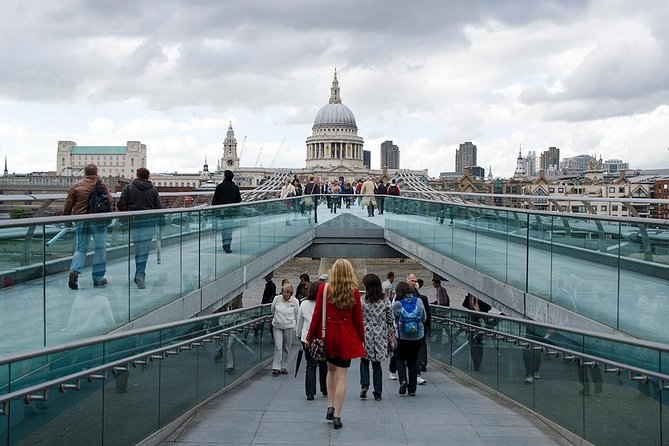
The Millennium Bridge links Tate Modern with the City and St Paul’s Cathedral. The footbridge opened on June 10, 2000, and stretches for 325 meters. Here, the route shifts from close urban details to strong lines and open views.
A bridge is an excellent photography subject because it naturally leads the eye. You can work with its length, repeating structure, and relationship to St Paul’s across the Thames. Your guide can suggest where to stand and how to use the bridge as more than a simple path from one bank to another.
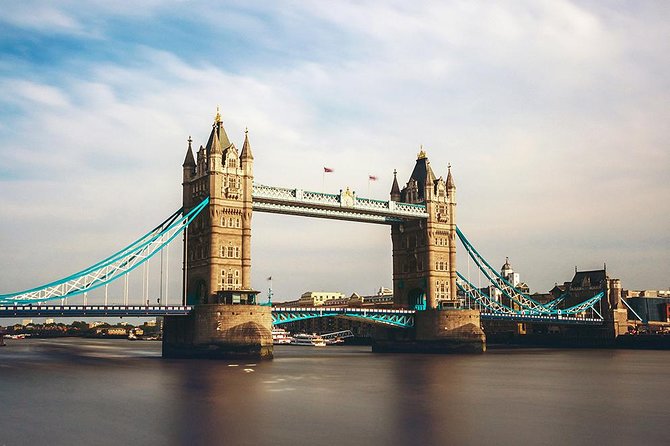
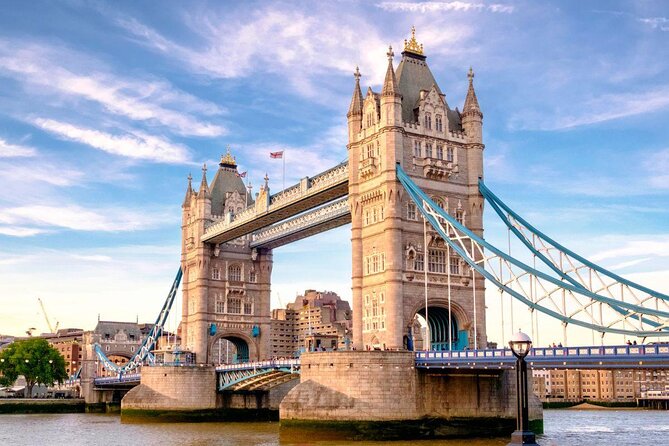
The walk then offers views of the Thames and Tower Bridge. The information provided for this stop does not promise a visit inside Tower Bridge, so think of it as a panoramic photo opportunity rather than an attraction admission. Ten minutes is enough to make several compositions, but not enough to wait for every possible change in traffic, light, or bridge activity.
This section may be the most rewarding for visitors hoping to build a personal London portfolio. You move from dense City streets to the broad river, then finish among the South Bank’s major cultural buildings. The change in scale gives your set of photographs more variety.
Tate Modern Is a Strong Finish
The tour ends at Tate Modern after about ten minutes focused on the building. Housed in the former Bankside Power Station, Tate Modern is a huge brick structure designed originally by Sir Giles Gilbert Scott, who also designed Battersea Power Station.
The building dominates this part of the South Bank, making it a useful final subject. Its industrial form is very different from St Mary Woolnoth, Guildhall, and St Paul’s. By this point, you have practiced religious architecture, civic buildings, memorial sculpture, bridges, and river views. Tate Modern gives you a final chance to combine scale, texture, and strong geometric shapes.
Ending here is practical. You can continue into the gallery separately, though entry to the museum is not part of the photography walk. The finish also gives you a clear transport and sightseeing point rather than leaving you in an obscure backstreet.
What the Photography Teaching Is Really Like
The strongest part of this experience is its useful, relaxed teaching style. Richard, one of the named guides, is particularly good at helping people who have become too comfortable with automatic settings on an SLR. That tells you something important about the level: you do not need to arrive as an experienced photographer.
The group can include beginners, people returning to photography, and camera users with different equipment. The guide’s role is to help you make better choices at the scene, including camera settings, composition, lighting, and viewpoint.
You can get more from the tour if you arrive ready to experiment. Bring a camera phone if that is what you use, but a dedicated camera gives you more settings to explore. Either way, pay attention to the reasoning behind the advice. Learning why an angle works is more useful than copying one position for a single building.
The experience is interactive rather than a lecture. You stop, photograph, ask questions, and move on. That format suits you if you learn by trying things immediately. It may suit you less if you want a formal classroom session with lengthy explanations of every camera function.
Price, Group Size, and Practical Value
The price is $71.63 per person for about two hours. That is not the cheapest way to walk through the City, since you can see these exterior landmarks without paying an admission fee. The value comes from combining a guided London walk with hands-on photography instruction.
If you already know your camera well and only want a standard sightseeing route, the cost may be harder to justify. You are paying for the guide’s eye, historical explanations, and help turning ordinary views into stronger photographs.
For someone who wants to improve, the price is more reasonable. A short lesson attached to real London subjects can be more memorable than generic camera instruction. You also finish with a varied set of subjects, from churches and banks to bridges and Tate Modern.
The maximum group size is 18. That is not a private experience, and you should not expect the guide to spend equal time with every person at every stop. It is still small enough for questions and shared learning, especially if the group remains engaged.
The tour is available by mobile ticket and starts near Bank. The end at Tate Modern means you are walking across a large part of central London, so wear shoes suited to pavement walking and allow for outdoor conditions. No food, drinks, camera equipment, or attraction admissions are included.
The cancellation terms are strict: the booking is non-refundable and cannot be changed for any reason. Poor weather or failure to reach the minimum number of participants can cause the experience to be canceled. In those cases, you are offered another date or experience, or a full refund. Check the forecast before booking, since rain and poor light can affect both comfort and photographs.
Who Will Get the Most From This Walk?
I would choose this tour if you want to improve your camera skills while seeing central London. It is especially suitable for:
- People who rely too heavily on automatic settings and want a gentle push toward manual control.
- Beginners who want guidance without signing up for a technical photography course.
- London locals who know the main landmarks but want to look at them from different angles.
- Visitors who prefer an active, creative way to sightsee.
- Photographers who want a mixed portfolio of architecture, sculpture, bridges, river views, and street scenes.
You should think twice if you want rare or very secluded locations. Most stops are well-known London sights, even though the guide may help you photograph them in less familiar ways. The route is about seeing standard landmarks with more care, not avoiding them entirely.
The minimum age is listed as 18. Children must be accompanied by an adult, and both need paid tickets, so confirm the age rule before booking if your party includes anyone under 18. Service animals are allowed, and the route is near public transportation. Most people can participate, but the experience is a walking tour through central London.
Final Verdict: Book It for Skills, Not Just Sightseeing
Book this photography tour if you want a compact introduction to photographing London and appreciate guidance from someone who understands cameras. Richard’s supportive approach, the mix of abilities in the group, and the route from Bank to Tate Modern make it useful for beginners and photographers getting back into regular shooting.
Skip it if you only want a fast list of famous sights, a private lesson, or a search for truly obscure locations. At $71.63, the walk earns its price through instruction and creative attention, not through paid entry to attractions. Bring your camera, expect a brisk route, and treat each landmark as a practice exercise rather than just another postcard view.
FAQ
How long does the History of London Photography Tour last?
The tour lasts approximately two hours.
Where does the tour begin?
It begins at IMPRINT Church London, St Mary Woolnoth, at 10 to 13 Lombard Street, London EC3V 9AN.
Where does the tour end?
The tour ends at Tate Modern, Bankside, London SE1 9TG.
Do I need to bring a camera?
Yes. You need a camera or camera phone to get the most from the experience.
Who leads the photography tour?
The tour is led by a professional photographer. Richard is one of the named guides associated with the experience.
How many people can join the tour?
The maximum group size is 18 people.
What happens if bad weather cancels the tour?
If poor weather causes cancellation, you are offered a different date or experience, or a full refund.
Latest arrivals on the London list
- Easy Access Tower of London Royal Secrets & Scandals Tour★ 5.0 · 3 reviews
- Stonehenge Special Access Guided Morning Tour from London★ 4.5 · 3 reviews
- Madame Tussauds London Fast Track and Champagne Experience★ 3.5 · 3 reviews
- Shoreditch & East London Walking Tour with a Local, Custom & Private★ 5.0 · 3 reviews
- London Private Brixton Tour with a Local – Culture & Stories★ 4.9 · 3 reviews
- Private Full Day Tour – Fast Track Tower of London and Lunch★ 4.6 · 3 reviews
- Private transfer from London Heathrow Airport to Southampton★ 5.0 · 3 reviews
- London Soho District – Guided Walking Tour 12 guests 2,5h★ 4.8 · 3 reviews
Historical Tours, compared.
Royal Historic Pubs Walking Guided Tour in London
Read our review →
Private Group: Historical Pub Walking Tour of London
Read our review →
Browse the lists this tour appears in