
Reviewed · HISTORICAL TOURS
London’s Alternative History: A Self-Guided Audio Tour
London’s grand sights often come with polished stories. This walk looks behind the curtain, explaining why Covent Garden has its name, where London’s first recorded punch-up took place, and how sewer gas once powered a street lamp. You finish at the Savoy after roughly an hour to 90 minutes of audio-guided walking.
I like the self-paced format and the way GPS starts the next piece of commentary as you reach each location. I also like the price: at $9.99, you get a compact London walk with offline maps and lifetime access, not just a one-time performance.
The main drawback is that this is an audio tour, not a person-led walk. You need a charged smartphone, headphones, and enough attention to follow the route. If you want lively conversation or detailed answers to questions, a live guide will suit you better.
In This Review
- Key points about London’s Alternative History walk
- Why this walk feels different from a standard London tour
- Starting with convent gardens in Covent Garden
- St Paul’s Church and London’s first recorded punch-up
- Drury Lane and the Man in Grey
- Legal oddities and famous trials
- The Lyceum Theatre and the arrival of electric stage lighting
- Somerset House, from Tudor palace to Navy office
- The Embankment and the Thames moved aside
- Waterloo Bridge, built largely by women
- Carting Lane and the lamp powered by sewer gas
- The Savoy and London’s first fully electric public building
- How the VoiceMap app works on the route
- Price, timing, and who gets the best value
- Should you book London’s Alternative History?
- FAQ
- How long does London’s Alternative History audio tour take?
- Where does the tour start?
- Where does the tour finish?
- What language is the tour offered in?
- Is a live guide included?
- Do I need a smartphone?
- Can I use the tour offline?
- Are entrance fees included?
- Can I bring a service animal?
- What is the cancellation policy?
Key points about London’s Alternative History walk
- Covent Garden to the Savoy: The route links major central London sights over about one to one and a half hours.
- Odd facts over standard commentary: Expect stories about actors, legal cases, electricity, women builders, and a lamp fueled by sewer gas.
- GPS-triggered narration: The VoiceMap app tells you where to turn and when to look around.
- Easy to fit into a busy day: Pause for food, photos, conversations, or an attraction, then continue when ready.
- Useful offline access: Download the audio, maps, and location data before setting out.
- Good value for independent walkers: The $9.99 cost covers one person and includes lifetime access.
Why this walk feels different from a standard London tour
The route does not try to explain all of London. Instead, it gathers a string of peculiar stories along a short central walk. That makes it a good choice if you have already seen the usual postcard sights and want some fresh details to attach to familiar streets.
You begin in Covent Garden and end at the Savoy, passing theatres, courthouses, riverside paths, bridges, and grand buildings. The route also ticks off several important London landmarks, but the commentary looks for the detail that usually slips past you.
I like that balance. You get a useful introduction to this part of central London without spending half a day in a museum or joining a fixed group. The tone is designed for walking, with directions mixed into the historical material rather than presented as a long lecture.
The route is private in the practical sense that only your group takes part. Still, it is not a private guide waiting at the start. You use the VoiceMap application, and the narration is recorded. That distinction matters if you are comparing this with a conventional private walking tour.
More London history walks:
- London Small Group Tour of Historical Pubs
★ 5.0 · 10,422 reviews - Soho Music & Historic Pubs Tour
★ 5.0 · 1,993 reviews - London: Historic Pubs of Central London Walking Tour
★ 4.9 · 1,065 reviews
Starting with convent gardens in Covent Garden
The walk starts at The Piazza, at 1 to 7 Covent Garden, WC2E 8HD. This is a sensible place to begin because the area is easy to recognize and offers an immediate story.
The name Covent Garden comes from Convent Garden, referring to the medieval convent’s garden that once occupied this ground. The modern market can feel far removed from that earlier use, which is exactly why the explanation works well. You are not simply hearing that a place is old. You are learning how its name preserves a clue to what once stood here.
The opening section helps you get your bearings while introducing the tour’s style. Look around as you listen, since the commentary is tied to the location rather than delivered as one uninterrupted recording.
The setting can be crowded, and that may affect the first few minutes. Give yourself room to stop safely and avoid starting while rushing through the Piazza. The walk is self-paced, so there is no need to keep moving while you are still figuring out the app.
St Paul’s Church and London’s first recorded punch-up
The next stop is St Paul’s Church in Covent Garden, often called the Actors’ Church. It is known for memorials connected with famous actors, making it a natural stop on a walk that pays attention to London’s theatrical past.
The less solemn detail is the location’s connection with London’s first recorded punch-up. That kind of fact gives the tour its personality. You move from memorials and formal remembrance to a very human quarrel, a useful reminder that London’s past was not made only by kings, playwrights, and grand buildings.
This stop should appeal to you if you enjoy small social details more than a list of dates. It also shows how the route moves between respectable public history and the city’s stranger anecdotes.
If you want to enter every building along the way, remember that admission is not included. The audio experience itself does not cover tickets to museums or other attractions, so treat the walk as an exterior tour unless you choose to pay for additional visits.
Drury Lane and the Man in Grey
The route continues to the oldest theatre site in London. This is a highlight for anyone interested in performance, stage superstition, or the way old buildings collect stories over time.
The theatre has a long record of productions and ghostly appearances, including the famous Man in Grey. The audio gives you a reason to look at the site as more than a theatre facade. You begin to see it as a place where performance, rumor, memory, and business have overlapped for generations.
The ghost story is a good example of the tour’s appeal. It adds atmosphere without requiring a separate ghost walk, and it gives the surrounding streets a little more character as you continue toward the next stop.
You should not expect a theatrical show or access to backstage areas. The value here comes from hearing the story in the place associated with it. If you like London’s stranger side, this section will probably stay with you.
A few more London days worth a look
- London: Emirates Stadium Entry Ticket and Audio Guide
★ 4.7 · 5,513 reviews - Westminster Abbey Entrance Ticket Including Audio Guide
★ 4.0 · 661 reviews - London: British Museum Audio Tour & Priority Entrance Ticket
★ 4.5 · 631 reviews - London: Churchill War Rooms Ticket & Political London Audio
★ 4.6 · 224 reviews
Legal oddities and famous trials
One stop focuses on intriguing cases and famous trials, showing the quirkier side of London’s legal past. The location is associated with major court proceedings, and the commentary uses those cases to move beyond dry legal history.
This part of the route gives the walk some variety. After churches and theatres, you are looking at how London dealt with crime, public order, and unusual disputes. It is a useful reminder that a city’s character can be found in its courts as much as in its palaces.
The stop may appeal most if you enjoy stories built around real events. You will get more from it if you pause and let the details settle rather than treating the tour as a race from one landmark to the next.
The route is advertised at about an hour to 90 minutes, but you control the pace. You can stop to talk, take photographs, or listen again. One useful feature of GPS audio is that you can pause the narration without losing your place.
The Lyceum Theatre and the arrival of electric stage lighting
The walk then reaches the theatre known for productions including The Lion King. It also connects with the early use of electricity for theatre lighting.
That combination links modern London entertainment with a major change in how theatres operated. You may know the building for its current productions, but the audio asks you to consider the technical shift that helped make modern stage design possible.
This is one of the route’s stronger stops because it connects something familiar with something less obvious. Many people can identify a famous theatre production. Fewer will have thought about the arrival of electric lighting as part of theatre history.
The tour does not include a show ticket. If you want to see a production, you will need to arrange that separately and allow much more time than the walking estimate. The audio stop works well on its own, so you do not need a performance booking to enjoy this part of the route.
Somerset House, from Tudor palace to Navy office
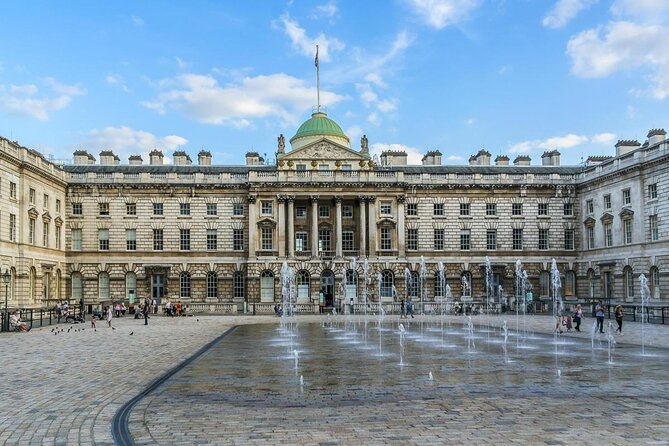
The route reaches Somerset House, a grand building with several surprising changes of use. The commentary explains its transformation from a Tudor palace to a Navy office, then connects it with the development of the British postal system.
This is the sort of stop that makes a self-guided tour worthwhile. You can look at the building and admire its scale, but the story gives you a better sense of how public institutions changed over time. A palace could become an office, and an office could play a role in systems that shaped everyday communication.
Somerset House also helps break up the route. Its open spaces and imposing architecture give you a natural place to pause, check the map, or decide if you want to spend longer in the area.
Any entrance fees to attractions are separate. The walk provides the commentary, maps, and location data, but it does not act as an admission pass.
The Embankment and the Thames moved aside
The riverside section follows the Embankment. The promenade itself has an unusual origin: its construction involved diverting the River Thames and exposed hidden secrets along the river.
This is a good place to slow down. The river gives you open views after the more enclosed streets around the theatres and courts, and the audio adds a layer of engineering and buried history to the walk.
I like the way this stop changes your view of the waterfront. The Embankment can look like a straightforward riverside road and walkway. Once you hear how it was built, you start to see it as a major act of urban engineering rather than a natural edge to the city.
The route’s riverside setting may be especially pleasant during daylight. The tour is technically available at any time because its hours run from midnight to midnight, every day, but the practical experience will depend on visibility, weather, and how comfortable you are walking outdoors.
Waterloo Bridge, built largely by women
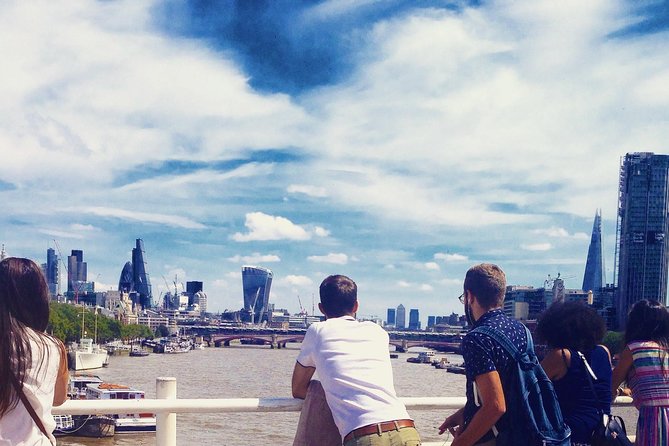
Waterloo Bridge is known as The Ladies’ Bridge because women carried out much of its construction during the Second World War. The stop also offers broad views across London.
This is one of the most memorable facts on the walk because it links a familiar crossing with the people who built it under wartime conditions. The bridge is not just a route from one side of the river to the other. It becomes a place connected with women’s work and the demands of wartime London.
The views are another reason to pause here. You can listen while looking across the city, then continue when you are ready. This is where the tour’s flexible format has real value. A live group might need to move on, but you can take extra time for photographs or simply enjoy the river.
The bridge is also a reminder to wear comfortable shoes. The total walk is short by London standards, but you will get more from it if you are happy on foot and not trying to squeeze it between tightly timed bookings.
Carting Lane and the lamp powered by sewer gas
One of the route’s most unusual stops is home to London’s last remaining Victorian gas lamp. It was powered by sewer gas, earning the nickname The Lamp that Lights Itself.
This is exactly the kind of detail that makes the tour more than a landmark checklist. You might walk past an ordinary-looking lamp without a second thought. The audio gives you a reason to stop and notice it, then explains the odd technology behind it.
The stop also fits the tour’s wider interest in how London worked below street level. The city’s sewers, gas systems, theatres, courts, and postal services all appear in different parts of the walk. You are hearing about the systems that helped the capital function, not just the people who made it famous.
Because the lamp is a small feature rather than a major attraction, it helps to keep your eyes open and listen for the location cue. GPS guidance is useful here, since the point of the stop may be easy to miss if you are simply following the busiest streets.
The Savoy and London’s first fully electric public building
The walk ends at the Savoy, at Strand, London WC2R 0EZ. The building is associated with luxurious accommodation and infamous parties, but its technical history is just as interesting.
The Savoy was the first public building in the world to be lit entirely by electricity. That fact provides a strong final stop because it ties together the route’s recurring interest in theatre lighting, gas, engineering, and modern city life.
The ending also gives the walk a clear sense of arrival. You begin with a medieval convent garden and finish in a landmark linked with luxury and new technology. Along the way, the stories move through performance, law, public works, wartime construction, and the river.
You can finish at the Savoy without booking a room, dining there, or entering any attraction. Food and drinks are not included, but the location may be a convenient point to end your central London walk.
How the VoiceMap app works on the route
The tour uses GPS-based audio, so the commentary is tagged to each location. You are told where to turn and when to look, which is useful if you are not confident with map directions.
The app includes offline access to the audio, maps, and geodata. I recommend downloading everything before you start, especially if you want to avoid relying on a mobile signal while walking.
You provide the smartphone. Headphones are not listed as an inclusion, so bring your own if you prefer not to use the phone speaker. A charged phone is essential because the tour depends on the VoiceMap application and GPS.
The narration is described as soothing and carefully paced. That matters more than it may sound. Audio that races ahead or uses a harsh delivery can make a walking tour tiring. Here, you can also pause whenever you want, which helps if you are walking with friends or stopping to talk.
Price, timing, and who gets the best value
At $9.99 per person, this is inexpensive for central London. The price includes lifetime access to the tour, the VoiceMap app, and offline audio, maps, and location data.
The lifetime access changes the value calculation. You can revisit the route later, repeat a favorite section, or use it on another day without paying again. It may also suit you if your first walk is interrupted by rain, a meal, or an attraction.
The advertised duration is approximately one hour to 90 minutes. In practice, your time can be longer because you decide how often to pause. One useful way to plan it is to allow at least 90 minutes if you want photographs and relaxed stops, even though the basic audio walk may be shorter.
This is best for independent walkers, couples, families with older children, and anyone with a spare part of the day. Most people can participate, and service animals are allowed. The route is near public transportation, but transportation itself is not included.
Free cancellation is available if you cancel at least 24 hours before the scheduled start time. Within 24 hours, the payment is not refunded, and late changes are not accepted.
Should you book London’s Alternative History?
Book it if you want a low-cost, flexible way to explore central London while hearing unusual facts that are easy to miss on your own. The strongest reasons are the clear GPS directions, the relaxed pacing, and the range of stories, from the Man in Grey to the sewer-gas lamp and the women who built Waterloo Bridge.
Skip it if you want a live guide, group conversation, or entry to the buildings along the route. You also need to be comfortable managing your own phone and navigation.
For $9.99, this is a practical choice for filling an open hour or two. Download the audio before leaving, wear comfortable shoes, and give yourself time to pause. If you enjoy the route, lifetime access lets you repeat it at a slower pace or return to the sections you found most memorable.
FAQ
How long does London’s Alternative History audio tour take?
The walk takes approximately one hour to one hour and 30 minutes. You can take longer because the audio can be paused whenever you want.
Where does the tour start?
It starts at The Piazza, 1 to 7 Covent Garden, London WC2E 8HD, United Kingdom.
Where does the tour finish?
The tour finishes at The Savoy on the Strand, London WC2R 0EZ, United Kingdom.
What language is the tour offered in?
The audio tour is offered in English.
Is a live guide included?
No. This is a self-guided audio tour using the VoiceMap application.
Do I need a smartphone?
Yes. A smartphone is not included, and you need one to use the VoiceMap app and GPS-based audio.
Can I use the tour offline?
Yes. Offline access to the audio, maps, and geodata is included.
Are entrance fees included?
No. Tickets or entrance fees for museums and other attractions along the route are not included.
Can I bring a service animal?
Yes. Service animals are allowed.
What is the cancellation policy?
You can receive a full refund if you cancel at least 24 hours before the experience start time. Cancellations or changes made within 24 hours are not accepted for a refund.
More Audio Tours in London
- Windsor Castle Tour from London with Transportation & Audio Guide
★ 3.5 · 222 reviews - London Panoramic Open Top Bus Tour with Audio Guide
★ 4.0 · 209 reviews - London: Royal Walking Tour and Buckingham Palace Audio Tour
★ 4.8 · 154 reviews - Emirates Stadium and Arsenal Museum Entrance Ticket Including Audio Guide
★ 4.5 · 113 reviews
Latest arrivals on the London list
- Stonehenge Special Access Guided Morning Tour from London★ 4.5 · 3 reviews
- Easy Access Tower of London Royal Secrets & Scandals Tour★ 5.0 · 3 reviews
- Shoreditch & East London Walking Tour with a Local, Custom & Private★ 5.0 · 3 reviews
- Madame Tussauds London Fast Track and Champagne Experience★ 3.5 · 3 reviews
- London Private Brixton Tour with a Local – Culture & Stories★ 4.9 · 3 reviews
- Private Full Day Tour – Fast Track Tower of London and Lunch★ 4.6 · 3 reviews
- Private transfer from London Heathrow Airport to Southampton★ 5.0 · 3 reviews
- London Soho District – Guided Walking Tour 12 guests 2,5h★ 4.8 · 3 reviews
Historical Tours, compared.
Royal Historic Pubs Walking Guided Tour in London
Read our review →
Private Group: Historical Pub Walking Tour of London
Read our review →
Browse the lists this tour appears in