
Reviewed · CITY TOURS
Money and Power in the City Sightseeing Tour
London’s financial district is much older and stranger than its glass towers suggest. This two-hour walk follows the story of money and power from Roman and medieval London to the modern stock market, with stops tied to merchants, guilds, coffeehouses, banks, and political influence.
I like the small group, capped at eight people, because it gives guide Terry room to answer questions and adjust his explanations. I also like the route’s mix of grand landmarks and tucked-away corners, including Exchange Alley, where coffeehouse trade helped shape the early stock market.
The main consideration is pace. Two hours covers a lot of ground, and the tour is mostly about outdoor views and storytelling rather than entering major buildings. If you want interior visits to St Paul’s Cathedral, the Bank of England, or the Guildhall, you’ll need to arrange those separately.
In This Review
- Key points to know before you book
- Why London’s City tells the story of power
- Starting near Emperor Trajan and the Roman City
- The East India Company and the reach of trade
- The Royal Exchange, Bank of England, and Mansion House
- Exchange Alley and the coffeehouse origins of trading
- Medieval Guildhall and the City’s guild buildings
- Modern finance beneath St Paul’s Cathedral
- What the $41.14 price gives you
- Who will get the most from this walk
- Should you book Money and Power in the City?
- FAQ
- How long does the Money and Power in the City tour last?
- What time does the tour begin?
- Where does the tour begin?
- Where does the tour finish?
- What language is the tour offered in?
- How large is the group?
- What is the price?
- Does the tour include a mobile ticket?
- Can I cancel for a full refund?
- What happens if bad weather cancels the tour?
Key points to know before you book
- Roman roots meet modern finance: The walk links the City’s earliest beginnings with the institutions that still define London’s business center.
- A maximum of eight people: The small group makes it easier to hear Terry, ask questions, and keep the tour personal.
- Exchange Alley adds texture: This narrow passage offers a direct connection to the coffeehouses where early stock trading took shape.
- The route includes major civic landmarks: You’ll see the Royal Exchange, Bank of England, Mansion House, Guildhall, and St Paul’s Cathedral.
- Terry focuses on context: His explanations connect past events to present-day London, making the City easier to understand.
- Plan around the weather: The experience requires good weather, and poor conditions may lead to a new date or a full refund.
Why London’s City tells the story of power
Many London walks focus on royal palaces, famous writers, or grand churches. This one takes a different route. It explains how commerce, political authority, overseas trade, and financial institutions shaped the City of London.
That subject can sound dry on paper. In practice, the route has plenty of hooks: old shortcuts, coffeehouse gossip, guild ceremonies, company wealth, trading scandals, and the contrast between medieval lanes and modern towers.
The City is compact, but its layers are easy to miss when you walk through it alone. You might pass a narrow alley without knowing it once connected important trading streets, or admire a grand building without understanding why it was placed there. A guide gives those places a purpose.
Terry’s role matters here. The strongest feedback about his guiding points to clear explanations, humor, energy, and a talent for making complex subjects easy to follow. That is useful on a tour like this, since the names and institutions can come quickly.
You do not need a background in economics or British history. The tour is designed to build a foundation, moving from early London to the present rather than assuming you already know how the City works.
A few more London days worth a look
- London: City Sights Hop-On Hop-Off Bus & Bookable Extras
★ 4.4 · 6,579 reviews - City Sightseeing London Hop-On Hop-Off Bus Tour & Bookable Extras
★ 4.0 · 1,224 reviews - London: Go City Explorer Pass® – Tickets for 2-7 Attractions
★ 4.3 · 1,111 reviews
Starting near Emperor Trajan and the Roman City
The meeting point is at Emperor Trajan, A100, London EC3N 4DR, with a 2:00 pm start. The opening section looks at the Roman and medieval beginnings of the financial district.
This is an important choice for the route. London’s financial center was not placed randomly in the modern era. Its location and street pattern grew from earlier settlements, trade routes, civic life, and the long development of the City.
The Roman and medieval material gives you a useful base for everything that follows. Before there were banks, stock exchanges, and global trading companies, there was a city with its own systems of authority, storage, trade, and public life.
I appreciate tours that begin with the foundations instead of rushing straight to famous buildings. Once you understand that London’s business center developed over many centuries, the later stops become easier to place.
The exact length of time spent at each location is not specified, so you should expect an interpretive walking tour rather than a formal lecture with a fixed schedule. Wear comfortable shoes and be ready to listen while standing outdoors.
The East India Company and the reach of trade
One stop focuses on the most important historic location connected with the East India Company, after seeing other places linked to it.
The company is an essential part of any discussion of money and power in London. It represents the way commerce could reach far beyond the City, tying finance and trade to overseas activity, political influence, and national ambition.
The value here is not simply seeing a building connected to the company. It is learning how one institution could affect London and the wider world. The tour places that story alongside other City landmarks, so you can see the relationship between commercial interests and civic power.
This section may appeal especially to you if you enjoy history that crosses borders. It also helps explain why London became such a major center of finance. The City was not only a place where people exchanged money. It was a place where decisions about trade and investment could have effects far away.
The tour description does not promise entry into East India Company sites, and you should expect to view locations from the route while hearing their stories. That is still valuable, but it is worth knowing if you prefer historic house interiors or museum displays.
The Royal Exchange, Bank of England, and Mansion House
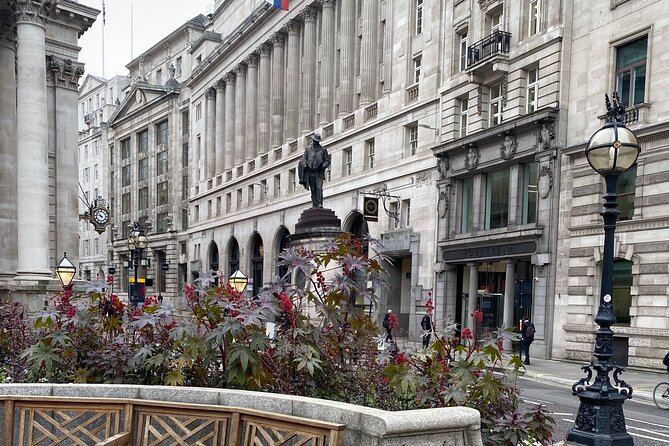
The route then reaches three of the City’s most important formal landmarks: the Royal Exchange, the Bank of England, and Mansion House.
The Royal Exchange brings the commercial side of the story into view. Its neo-classical design gives the building a grand public face, fitting its role in the City’s trading life. You will hear how it relates to the people and institutions that made London a center for business.
The Bank of England shifts the focus toward national finance and monetary authority. Mansion House adds the civic and political side of the City, showing that local business power and public leadership have long operated close together.
This combination is one of the tour’s strengths. Instead of treating each building as an isolated photo stop, the walk connects them. You begin to see how trade, banking, and civic government occupied the same small area.
The buildings are visually impressive, but the explanation is what gives them weight. Without context, the Royal Exchange can look like a beautiful old landmark. With context, it becomes part of a much bigger story about who controlled credit, trade, and public life.
The tour is conducted in English, so it suits you best if you are comfortable following spoken explanations while walking. Since the group is limited to eight, questions should be easier to ask than on a large coach tour.
Something completely different for your London days:
- London: The London Eye Entry Ticket
★ 4.6 · 35,875 reviews - From London: Harry Potter Warner Bros Studio Tour
★ 4.7 · 26,588 reviews - London: Westminster to Greenwich River Thames Cruise
★ 4.5 · 22,836 reviews - Magical London: Harry Potter Guided Walking Tour
★ 4.7 · 22,044 reviews
Exchange Alley and the coffeehouse origins of trading
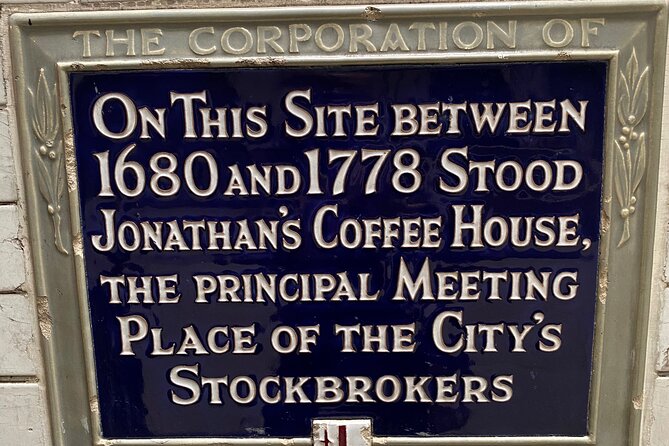
One of the most distinctive parts of the walk is Exchange Alley, also called Change Alley. This narrow passage connects Cornhill and Lombard Street and historically offered a shortcut between the Royal Exchange and the Post Office.
It is easy to hurry through a lane like this. The tour slows the moment down by explaining its connection with shops and coffeehouses, including the coffee shop location where the stock market was first based.
That detail gives the financial district a more human scale. Early trading did not begin in a sleek tower with electronic screens. It grew through conversations, relationships, information, rumor, and transactions in public meeting places.
Exchange Alley also suits the tour’s promise of gossip and scandal. Financial history is not only a sequence of laws and institutions. It involves ambition, competition, speculation, and the personal stories that made business news exciting long before modern media.
For me, this is likely to be one of the most memorable sections because it brings abstract financial history down to street level. You are not just hearing about the birth of stock trading. You are seeing the kind of cramped urban setting where those networks developed.
The drawback is that the lane itself is narrow and may not offer a dramatic visual display. Its importance comes from the explanation, so pay close attention rather than expecting a major monument.
Medieval Guildhall and the City’s guild buildings
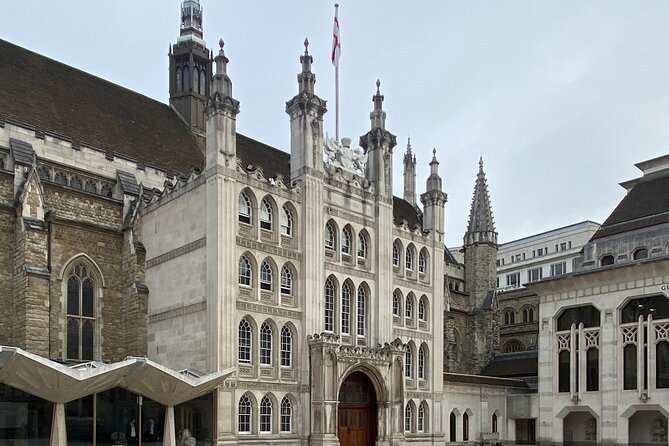
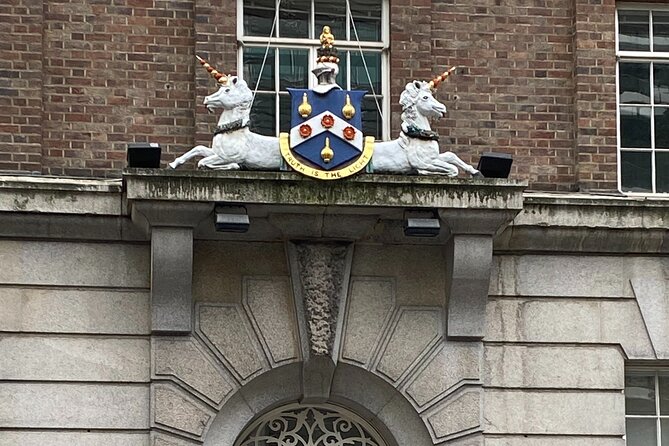
The route continues to the medieval Guildhall and selected nearby guild buildings. Medieval guild halls were used to store goods and to hold celebrations, but their role could extend into public entertainment when guild members did not need the space.
That makes the Guildhall more than an old building to photograph. It reflects how trade, social life, ceremony, and civic identity overlapped in medieval London.
The mention of Passion plays adds another useful layer. Guild halls were not only private business venues. They could become places where townspeople gathered for performances and public events.
This stop helps balance the grand financial institutions earlier in the route. The City’s power did not begin with banks and stock markets. It developed through organized trades, merchants, civic groups, and communities that controlled goods and public life.
You will see selected guild buildings in the area, though the information provided does not promise interior access. If you want to explore the Guildhall inside, check separately for opening times and admission. The walking tour itself is focused on the surrounding streets and the stories connected to them.
I like this part for families and first-time visitors because it shows that medieval London was not just a maze of old streets. It had systems, organizations, and buildings that helped manage work and community life.
Modern finance beneath St Paul’s Cathedral
The final section brings the story to modern stock trading, with the contemporary market area towered over by St Paul’s Cathedral.
The contrast is powerful. St Paul’s sits on Ludgate Hill, the highest point in the City, while the modern financial world continues below it. The cathedral is the seat of the Bishop of London and the mother church of the Diocese of London, but on this walk it also acts as a visual marker for the long span of London’s development.
The final view gives the tour a strong closing idea: money and power have changed their buildings, methods, and scale, but they remain tied to the same compact part of the city.
The endpoint is the London Stock Exchange at 10 Paternoster Square, by the main column. This is close to St Paul’s Cathedral and provides a practical place to continue exploring after the walk.
You might choose to visit the cathedral, explore Paternoster Square, or continue toward other City sights. The tour itself does not include cathedral admission, so treat the final view as part of the walking experience rather than a church visit.
Ending here also makes sense geographically. You begin with early London and finish beside a modern financial institution, with St Paul’s connecting the two eras.
What the $41.14 price gives you
At $41.14 per person, this is not a bargain-priced orientation walk, but the small group changes the value calculation. A maximum of eight people means you are paying for access to a focused guide rather than simply following a large crowd.
The price makes the most sense if you want interpretation. The City’s buildings and streets are free to see, but the connections between them are not obvious. Terry’s explanations are the main product, especially when he links Roman beginnings, medieval guilds, overseas trade, coffeehouse finance, and the modern stock market.
Two hours is also a useful length. It is long enough to establish a clear story without taking up an entire day. You can schedule it early in your London visit, then use what you learn to understand the City better on later walks.
The value is lower if you mainly want entry tickets, long stops inside buildings, or a general sightseeing route with little history. This is an outdoor history walk, not an attraction pass.
The tour is booked an average of 33 days in advance, which suggests you should not leave it until the last moment if the timing matters to you. Confirmation is provided at booking, and free cancellation is available up to 24 hours before the start time.
Who will get the most from this walk
I would recommend this tour to you if you enjoy seeing how a city works beneath its postcard image. It is especially suited to first-time visitors who want a clear foundation for London’s City, as well as returning visitors who have seen the landmarks but never understood their connections.
It should work well for families too. One particularly useful feature of Terry’s approach is his ability to meet people at different levels of prior knowledge, so you do not need everyone in your group to share the same background.
The tour also fits history fans interested in institutions, trade, politics, and urban development. If your interests run only to royal palaces or art museums, the financial focus may feel less natural.
Most people can participate, and service animals are allowed. The tour operates near public transportation, which makes the central meeting and ending points practical. Since it requires good weather, check the forecast before setting out and keep some flexibility in your plans.
Should you book Money and Power in the City?
Book it if you want London explained through its streets, companies, guilds, banks, and trading places. The strongest reason to choose it is the combination of a very small group and a guide who can turn complex financial and political history into a clear, entertaining story.
I would place it early in a London visit. The walk can give you a useful framework for later visits to the City, St Paul’s Cathedral, and other historic sites.
Skip it if you want extensive indoor access or a broad tour of all central London. This route stays focused on the City and its connection to money and power. For the right audience, $41.14 buys a thoughtful two hours and a much better understanding of why this small part of London matters.
FAQ
How long does the Money and Power in the City tour last?
The tour lasts approximately two hours.
What time does the tour begin?
The stated start time is 2:00 pm.
Where does the tour begin?
The meeting point is Emperor Trajan, A100, London EC3N 4DR, United Kingdom.
Where does the tour finish?
The tour ends at the London Stock Exchange, 10 Paternoster Square, London EC4M 7LS. The meeting location at the endpoint is by the main column in Paternoster Square.
What language is the tour offered in?
The tour is offered in English.
How large is the group?
The experience has a maximum of eight participants.
What is the price?
The listed price is $41.14 per person.
Does the tour include a mobile ticket?
Yes. A mobile ticket is available.
Can I cancel for a full refund?
Yes. You can cancel at least 24 hours before the start time for a full refund. Cancellations made less than 24 hours before the start time are not refunded.
What happens if bad weather cancels the tour?
The experience requires good weather. If poor weather causes a cancellation, you will be offered another date or a full refund.
Latest arrivals on the London list
- Easy Access Tower of London Royal Secrets & Scandals Tour★ 5.0 · 3 reviews
- Stonehenge Special Access Guided Morning Tour from London★ 4.5 · 3 reviews
- Shoreditch & East London Walking Tour with a Local, Custom & Private★ 5.0 · 3 reviews
- Madame Tussauds London Fast Track and Champagne Experience★ 3.5 · 3 reviews
- Private Full Day Tour – Fast Track Tower of London and Lunch★ 4.6 · 3 reviews
- Private transfer from London Heathrow Airport to Southampton★ 5.0 · 3 reviews
- London Private Brixton Tour with a Local – Culture & Stories★ 4.9 · 3 reviews
- London Soho District – Guided Walking Tour 12 guests 2,5h★ 4.8 · 3 reviews
City Tours, compared.
City Sights Hop-On Hop-Off Bus & Bookable Extras
Read our review →
City Sightseeing London Hop-On Hop-Off Bus Tour & Bookable Extras
Read our review →
Go City Explorer Pass® – Tickets for 2-7 Attractions
Read our review →

Upside Down House Westfield White City Entry Ticket
Read our review →
Westminster Abbey Priority Access & Guided City Tour
Read our review →
Eating London: The Heart of ‘The City’ Food Tour
Read our review →
London Luxury Dinner Experience with Panoramic City Views
Read our review →Browse the lists this tour appears in