
Reviewed · 3-DAY EXPERIENCES
3-Day Isle of Wight and the Southern Coast Small-Group Tour from London
The best part of this tour is the change of pace: within three days, you move from London’s crowded streets to Portsmouth’s naval waterfront, the chalk cliffs of the Isle of Wight, and the quiet lawns of Runnymede. It gives you a useful taste of southern England without the work of renting a car, arranging ferries, or finding two nights of lodging.
I like the small 16-person group, which keeps the trip more personal than a full-size coach tour. I also like the mix of grand sights and less obvious stops, especially Osborne House, Quarr Abbey, and St. Catherine’s Down. The main drawback is the brisk schedule: some stops receive only 30 minutes, and your free time in Portsmouth and Winchester will not cover everything.
In This Review
- Key points to know before booking
- Why this three-day route works
- Day one: Portsmouth before the ferry
- Quarr Abbey and the first taste of island life
- Day two: royal rooms, white cliffs, and island views
- Osborne House: Queen Victoria’s private retreat
- The Needles: the Isle of Wight’s signature view
- St. Catherine’s Down at the end of the day
- Day three: Winchester and the meaning of Runnymede
- Life aboard the 16-seat mini-coach
- Guide service and the feel of the group
- Who will get the most from this tour
- Should you book the Isle of Wight tour?
- FAQ
- Where does the tour depart from?
- What time should I arrive?
- Where do I stay during the tour?
- Is food included?
- Which admission fee is included?
- Can I bring a wheelchair?
Key points to know before booking
- Two nights in Shanklin: You use one Isle of Wight base instead of changing hotels every night.
- Osborne House included: Queen Victoria’s Italianate seaside home is the tour’s main paid attraction.
- A 16-seat Mercedes mini-coach: Smaller transport makes narrow roads and group movement easier, but there is no toilet onboard.
- A useful southern England mix: Portsmouth, the Isle of Wight, Winchester, and Runnymede each offer a different kind of history.
- Hotel choice matters: B&Bs may sit on the edge of town, while hotels are usually more central.
- Strong guide service: Mark is specifically praised for being engaging, amusing, interesting, and professional.
Why this three-day route works
The Isle of Wight is close to mainland England, yet it feels like a proper break from London. Getting there independently means coordinating trains, local buses, a ferry, and accommodation. This tour handles the transport and gives you a driver-guide who explains what you are seeing along the way.
The route also avoids the common problem of a tour that is all castles or all scenery. You get naval history in Portsmouth, religious architecture at Quarr Abbey, royal interiors at Osborne House, sea cliffs at the Needles, and constitutional history at Runnymede.
The price is $744.73 per person. That is not a budget day trip, but it includes two nights of en-suite accommodation, breakfast, transport, the driver-guide, and entry to Osborne House. You still pay for most meals and optional admissions, so budget extra for food, drinks, and any attractions you choose in Portsmouth or elsewhere.
For the right person, the value comes from convenience. You are paying to avoid driving on unfamiliar roads, arranging the ferry, and solving the Isle of Wight’s transport puzzle yourself. If you already have a car and enjoy planning every stop, the package may feel less attractive.
A few more London days worth a look
- Edinburgh, Loch Ness, The Highlands from London – 3 Day Rail Tour
★ 4.0 · 40 reviews - 3-Day Stonehenge*, Glastonbury, Bath & the South West Coast Tour from London
★ 4.5 · 32 reviews - London: 3 Days of Must-See Attractions including London Eye
★ 4.5 · 22 reviews
Day one: Portsmouth before the ferry

Meet at Green Line Coach Station on Bulleid Way in London at 9:30 a.m. Check-in closes 15 minutes before departure, and the coach leaves on time. This is a busy transport area, so public transport is a better choice than trying to park in central London.
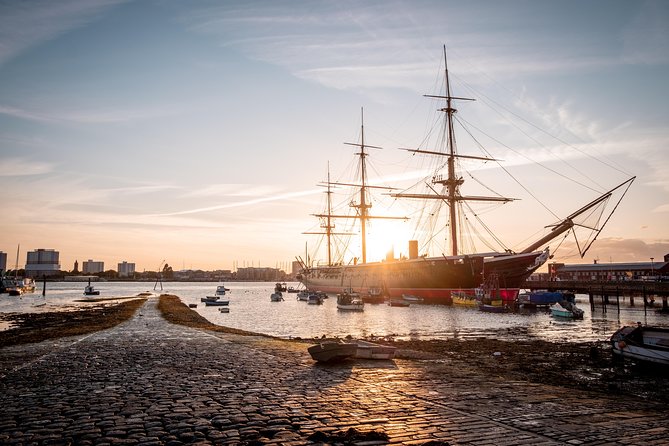
The first major stop is Portsmouth, an old port city with a strong naval identity. You have free time from roughly 11 a.m. to 1 p.m., which is enough for a walk around the harbor area and one well-chosen attraction.
The Spinnaker Tower gives you high views over Portsmouth, the Isle of Wight, and the southern coast. The tower rises 170 meters, so it offers a broad look at the area before you cross the water. Admission is not listed as included, so check the cost before committing your limited time.
The other big choices are the Mary Rose and HMS Victory. The Mary Rose was King Henry VIII’s warship, lost in 1545 and later raised from the seabed. HMS Victory is associated with Admiral Nelson and the Battle of Trafalgar. Both can take more than a quick glance, so reserve tickets ahead if you want to visit them. Trying to fit both into the Portsmouth break would make the stop feel rushed.
You then meet the guide at Gunwharf Terminal for the ferry to the Isle of Wight. The ferry crossing is part of the route rather than a separate problem for you to solve. After arrival, Quarr Abbey provides a calmer first look at the island.
Quarr Abbey and the first taste of island life
Quarr Abbey is an important religious site, and its architecture mixes French, Byzantine, and Moorish influences. That blend gives the stop more visual interest than a standard church visit. You have about an hour, and admission is not included in the tour price. Tickets are reserved for the group, but you purchase your own ticket while on the tour.
This is also a useful shift in mood. Portsmouth is tied to warships and national power. Quarr Abbey is quieter and more reflective, with the building itself doing much of the talking. Your guide can add context, but allow some time simply to look at the unusual design.
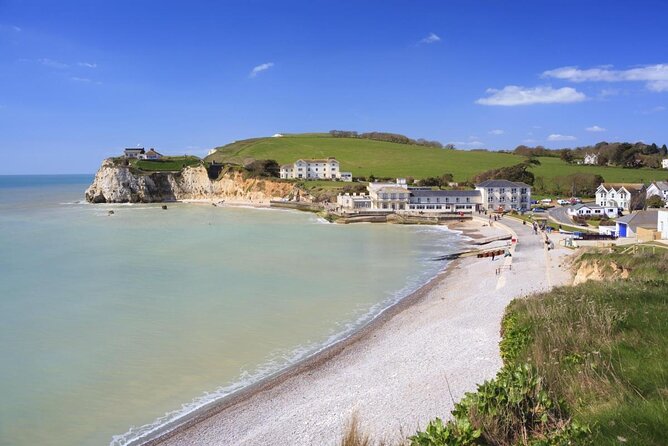
After Quarr Abbey, you continue to Shanklin, where you spend both nights. That fixed base is a real advantage. You do not unpack and repack each morning, and you can get to know one part of the island rather than sleeping in a different town every night.
Accommodation is either a three-star B&B or a three-star hotel, selected when you book. B&Bs tend to be on the outskirts and can require a 20 to 30 minute walk to pubs and restaurants. Hotels are generally more central, though they may also be a similar distance from local facilities. If stairs are difficult, say so before the tour, since lifts are not guaranteed in B&Bs and hotel lift access depends on availability.
Day two: royal rooms, white cliffs, and island views

Day two covers the Isle of Wight’s most famous sights. It is also the fullest day, so wear shoes that can handle walking and dress for changing weather.
The Earl Yarborough’s Monument is a short stop of about 30 minutes. It honors a wealthy 19th-century earl and is the tallest monument on the island. The value here is less about a long visit and more about seeing a landmark connected to the island’s aristocratic past.
Something completely different for your London days:
- London: The London Eye Entry Ticket
★ 4.6 · 35,875 reviews - From London: Harry Potter Warner Bros Studio Tour
★ 4.7 · 26,588 reviews - London: Westminster to Greenwich River Thames Cruise
★ 4.5 · 22,836 reviews - Magical London: Harry Potter Guided Walking Tour
★ 4.7 · 22,044 reviews
Osborne House: Queen Victoria’s private retreat
Osborne House is the day’s main attraction and the only listed entry fee included in the tour price. Queen Victoria used it as a holiday home, and the design looks more like an Italian Renaissance palazzo than a traditional English royal residence.
Inside, you can expect ornate rooms, gold details, and personal objects that make the house feel more like a lived-in retreat than a formal state palace. The gardens add another layer, with open green space around the elaborate building.
You have about an hour here. That is enough for a focused visit, but not enough to examine every room and garden at a slow pace. If royal interiors are your main interest, you may want more time than the tour allows. Still, including Osborne House in the package saves you an extra admission charge and gives the day a clear center.
Osborne House also helps explain Queen Victoria away from the official ceremonies of London. The setting shows her preference for a private family retreat, while the architecture reveals how strongly the royal household admired Italian style.
The Needles: the Isle of Wight’s signature view
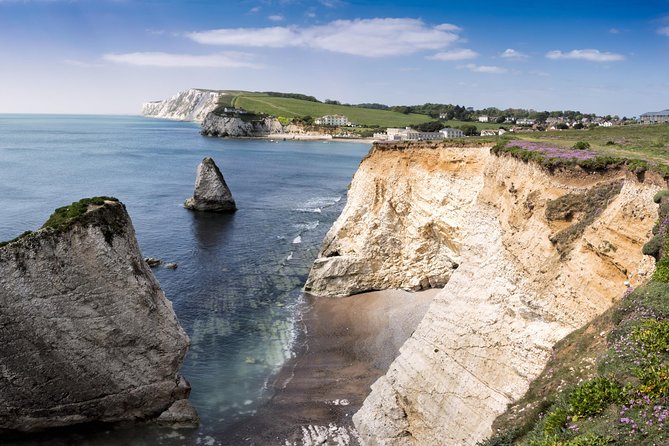
The Needles are the island’s most recognizable natural sight: pale chalk stacks rising from the sea at the western tip. You have about 30 minutes, so plan on a quick look and photographs rather than a long walk.
A boat trip can take you closer to the stacks, and an old defensive battery sits nearby. These options may require extra time and payment, and the tour does not include general admission fees unless specifically stated. If you choose the boat, keep an eye on the schedule so you return to the coach promptly.
The short stop works well for anyone who wants the classic view without spending half a day on one attraction. It is less suitable if you want a long coastal walk or time to explore every part of the defensive site.
St. Catherine’s Down at the end of the day
St. Catherine’s Down brings you to cliffs, green valleys, and open views as the day fades. The stop lasts about 30 minutes, but the timing gives it a special quality. Light changes quickly near the coast, and late-day views can feel more dramatic than a midday visit.
This is one of the places where sensible clothing matters. Wind and weather can change on exposed ground, even when conditions in town seem mild. Afterward, you return to Shanklin in time for dinner.
Because food is not included, you are free to choose your own evening meal. The location of your accommodation affects how easy this is. A hotel may make the walk simpler, while a B&B on the outskirts may require more planning or a longer walk.
Day three: Winchester and the meaning of Runnymede
The final day leaves the island and heads back toward London, with two worthwhile stops on the mainland.
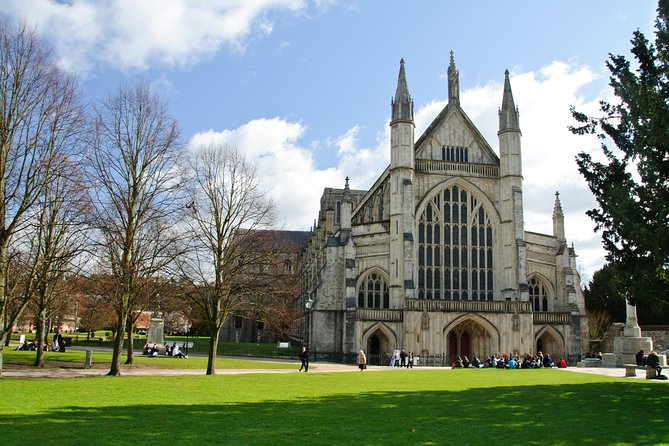
Winchester is an old English city with far more sights than you can fit into an hour. The cathedral is the obvious draw, but the city also has an ancient mill, museums, cafes, and historic streets. Admission to the cathedral and other attractions is not included, so you need to choose between paying to enter one site or using the time for a walk.
An hour here is best treated as an introduction. You can get your bearings, see part of the center, and perhaps visit one attraction if timing allows. You will not experience the whole city, but the stop may help you decide to return for a longer visit on another trip.
Runnymede offers a different kind of historical setting. The meadow is linked to the sealing of Magna Carta by King John on June 15, 1215. The 1225 version later became the definitive text, and the site is often connected with the development of modern democratic ideas.
The area also contains several memorials, including the Magna Carta memorial from 1957, the John F. Kennedy memorial from 1965, and the Commonwealth Air Forces memorial from 1953. You have about 30 minutes, so this is a short outdoor visit rather than a museum-style lesson.
Runnymede works because it gives the return journey a final point of meaning. After royal homes, military ports, and coastal defenses, you finish in a peaceful meadow tied to law and political rights. The stop is simple, but the subject is large.
Life aboard the 16-seat mini-coach
The tour uses a top-range 16-seat Mercedes mini-coach and caps the group at 16 people. That size is a good middle ground. You get more room for questions and conversation than on a large coach, while the vehicle remains large enough for luggage and longer road sections.
There are three steps into the coach, each about 150 millimeters high. Grab handles, marked step edges, and non-slip treads help, but the vehicle is not wheelchair accessible. A folding wheelchair or walking frame can be stored, though you must get on and off the coach yourself or with help from a companion.
There is no restroom onboard. Regular breaks are built into the day, but you should use facilities whenever the group stops. This matters most on the longer stretches between London, Portsmouth, and the island.
The luggage rules need care because the supplied tour details give two different limits. The main information says 20 kilograms per person, with one airline-style case measuring about 55 by 45 by 25 centimeters plus a small personal bag. The FAQ gives a lower limit of 14 kilograms. I would confirm the current allowance before packing and bring the smallest practical case either way.
Guide service and the feel of the group
Your English-speaking driver-guide handles both the road and the commentary. Mark is specifically praised for being engaging, amusing, interesting, and professional, qualities that matter on a three-day route with long stretches between stops.
A good guide can make short visits work by explaining what deserves your attention before you step off the coach. That is especially useful in Portsmouth, Winchester, and at the Needles, where you have several choices but little time.
The group limit also helps with basic logistics. Sixteen people can board the ferry, gather at meeting points, and move through attractions without the stop-start feel of a much larger group. The tradeoff is that the route follows the group schedule. If you linger at Osborne House or want a longer walk at St. Catherine’s Down, you cannot simply extend your visit.
Who will get the most from this tour
I would choose this tour if you want a well-organized introduction to the Isle of Wight and southern England, especially if you are staying in London without a car. It suits visitors who value scenery, royal history, historic towns, and a guide’s local explanation more than long independent stays in each place.
It is also a good fit for solo visitors and couples who want transport and accommodation arranged together. The small group should feel more manageable than a standard sightseeing coach, and the two-night stay in Shanklin keeps the trip from becoming a constant hotel transfer.
I would hesitate if you need a slow pace, long hikes, or extensive time inside museums. The schedule is built around highlights, not deep visits. Families should note that children must be at least five years old, and anyone under 18 must travel with an adult. Children under 1.35 meters may need a booster seat, which should be requested in advance.
The tour is available in English and begins and ends at the Green Line Coach Station in London. Hotel pickup and drop-off are not provided, so allow enough time to reach Bulleid Way on the first morning and collect your belongings at the end.
Should you book the Isle of Wight tour?
Book it if you want to see a broad slice of southern England in three days without driving, planning ferry connections, or changing hotels each night. The strongest reasons are the small group, Osborne House admission, the fixed Shanklin base, and the range of places covered.
Think twice if the $744.73 price stretches your budget or if you prefer to spend a full day at one attraction. You will also need to pay for meals, Quarr Abbey, and optional admissions in Portsmouth and elsewhere.
For a first visit, I think the route offers a sensible balance. It gives you the Isle of Wight’s signature sights, adds worthwhile mainland stops, and leaves you with enough structure to enjoy the trip without managing every detail yourself.
FAQ
Where does the tour depart from?
The tour departs from Green Line Coach Station on Bulleid Way, London SW1W 9SA. It returns to the same meeting point at the end.
What time should I arrive?
The tour starts at 9:30 a.m. Check-in closes 15 minutes before departure, and the coach leaves on time.
Where do I stay during the tour?
You spend two nights in Shanklin on the Isle of Wight. You choose between a three-star B&B and a three-star hotel when booking.
Is food included?
No. Breakfast is included with the accommodation, but lunch, dinner, drinks, and other food are not included.
Which admission fee is included?
Entry to Osborne House is included. Quarr Abbey, the Spinnaker Tower, the Mary Rose, HMS Victory, the Needles boat trip, Winchester attractions, and other optional sites require separate payment unless specifically stated otherwise.
Can I bring a wheelchair?
The mini-coach is not wheelchair accessible, but storage is available for a folding wheelchair or walking frame. You must be able to board and leave the coach independently or with help from a companion.
Latest arrivals on the London list
- Easy Access Tower of London Royal Secrets & Scandals Tour★ 5.0 · 3 reviews
- Stonehenge Special Access Guided Morning Tour from London★ 4.5 · 3 reviews
- Shoreditch & East London Walking Tour with a Local, Custom & Private★ 5.0 · 3 reviews
- Madame Tussauds London Fast Track and Champagne Experience★ 3.5 · 3 reviews
- London Private Brixton Tour with a Local – Culture & Stories★ 4.9 · 3 reviews
- Private Full Day Tour – Fast Track Tower of London and Lunch★ 4.6 · 3 reviews
- Private transfer from London Heathrow Airport to Southampton★ 5.0 · 3 reviews
- London Soho District – Guided Walking Tour 12 guests 2,5h★ 4.8 · 3 reviews
3-Day Experiences, compared.

Edinburgh, Loch Ness, The Highlands from London – 3 Day Rail Tour
Read our review →
3-Day Stonehenge*, Glastonbury, Bath & the South West Coast Tour from London
Read our review →
3 Days of Must-See Attractions including London Eye
Read our review →

Browse the lists this tour appears in