
Reviewed · HISTORICAL TOURS
City of London History Tour: The Square Mile that Rose to Empire
London’s Square Mile is small enough to cross on foot, yet its story runs from Roman Londinium to global finance. This tour follows that story in a tidy 2.5-hour walk, beginning near the Barbican and ending by the Bank of England and London Troops War Memorial.
I like the unusual route, which includes Roman walls, old churches, livery halls, Guildhall, the Royal Exchange, and a Roman amphitheatre. I also like the small group limit of eight, which should make it easier to hear Argun’s explanations and ask questions. The main drawback is simple: this is a walking tour with many short stops, so anyone wanting long indoor visits or extended time at each landmark may find the pace brisk.
In This Review
- Key points to know before booking
- Why the Square Mile deserves its own walking tour
- From St. Alphage to London Wall
- Churches, gardens, and the companies that shaped trade
- St. Mary Aldermanbury and the meaning of civic government
- Guildhall, St. Lawrence Jewry, and the Roman amphitheatre
- Livery companies, royal exchange, and the golden grasshopper
- Mansion House and the financial heart of London
- Ending among dragons and war memorials
- Is $30.69 a fair price?
- Who should book this City of London walk?
- Should you book it?
- FAQ
- How long does the City of London History Tour last?
- How much does the tour cost?
- Where does the tour begin?
- Where does the tour end?
- What language is the tour offered in?
- How many people can join the tour?
- Is the tour wheelchair and stroller accessible?
- Can I cancel for a full refund?
Key points to know before booking
- Roman beginnings: Start with London Wall, the fortifications that helped protect Londinium and set the scene for the city’s earliest growth.
- A different side of London: See livery company buildings, old church sites, gardens, and civic landmarks that many first-time visitors miss.
- Guildhall at the center: Learn how the City of London’s government, mythology, trade, and public life meet around this long-standing town hall.
- Small-group format: The tour has a maximum of eight people, a useful size for a history-focused walk.
- A strong finish: End near the Bank of England, Mansion House, the Royal Exchange, and the dragon-marked London Troops War Memorial.
- Good practical value: At $30.69 per person, the price is modest for 145 minutes of guided history, especially if you want context rather than only exterior photographs.
Why the Square Mile deserves its own walking tour
Many London visitors think of the City as a cluster of offices and financial institutions. That view misses the older story under your feet. The Square Mile is the historic center of London, and this walk shows how Roman defenses, medieval churches, trade guilds, civic government, and modern finance grew together.
The route is especially useful if you are new to London. It gives you a framework for places you may otherwise pass without understanding. A church garden becomes a clue to medieval administration. A golden grasshopper becomes a symbol with a story. A circle of dragon-topped lamps helps explain the structure of the City’s livery companies.
I also like that the walk does not rely only on the most familiar sights. Guildhall, the Royal Exchange, Mansion House, and the Bank of England are important, but the tour also makes room for St. Alphage, Salters Garden, Brewers’ Hall, St. Mary Aldermanbury Garden, and St. Giles Cripplegate.
Argun’s approach, based on the available tour details, is strongly focused on explanation. The tour is designed for history buffs, but the material is also useful for first-time visitors who want more than a quick look at London’s headline attractions.
More London history walks:
- London Small Group Tour of Historical Pubs
★ 5.0 · 10,422 reviews - Soho Music & Historic Pubs Tour
★ 5.0 · 1,993 reviews - London: Historic Pubs of Central London Walking Tour
★ 4.9 · 1,065 reviews
From St. Alphage to London Wall

The walk begins at Barbie Green, near London Wall and the Barbican, with St. Alphage London Wall. The opening stop lasts about 15 minutes and introduces the main idea of the tour: many peoples and eras meet in this small part of London.
You will hear about the Roman, Norman, and earlier Celtic presence connected with the area. This is a good beginning because it avoids treating London as a city that appeared fully formed. Instead, you start with layers of settlement, conflict, governance, and trade.
The Roman city wall follows for about 10 minutes. The oldest section here is described as a fort, and the wall itself gives you something solid to look at while the story moves back to Londinium. The Romans built the wall to fortify the city, and the tour also considers the Celtic people who lived in the region before Roman control.
That pairing matters. You are not looking only at an ancient stone fragment. You are considering why the Romans thought a fortified city was needed and how earlier inhabitants fit into the story.
The wall is an outdoor stop, so expect a visual explanation rather than a museum-style display. If you enjoy ruins and urban archaeology, this part should be one of the strongest sections. If your main interest is royal London or grand interiors, the opening may feel less immediately familiar.
Churches, gardens, and the companies that shaped trade
St. Giles Cripplegate is the next stop, with about 10 minutes devoted to one of the City’s oldest medieval churches. The church is associated with Norman times and with the site of an earlier Saxon church.
This stop helps show how religious buildings anchor the City’s long civic story. You are not simply checking off another church. You are looking at a place where older religious foundations, medieval rebuilding, and later London life overlap.
At Salters Hall Garden, the tour returns to the Roman wall and then shifts toward the livery companies. Salters Hall ranks ninth among the 12 most important livery companies, formerly known as guilds. The discussion links these organizations with trade, governance, and sacrifice, three ideas that recur throughout the City.
The garden setting should make this a pleasant pause in the walk. It also gives the tour a chance to explain why the City contains so many formal halls and why their names appear throughout local streets and institutions.
Brewers’ Hall receives another 10-minute stop. The company is presented as the livery organization that set standards for the brewing trade. This is one of the tour’s more approachable subjects because it connects civic history with an everyday product.
You will not need to know the structure of London’s guilds before arriving. The value here is seeing how organized trades helped shape the City and how those groups remain part of its identity.
St. Mary Aldermanbury and the meaning of civic government
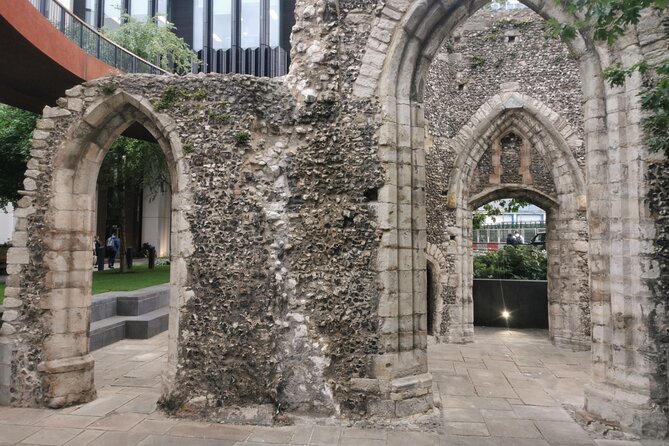
St. Mary Aldermanbury Garden is a compact stop with a solemn side. The ruins of the church take their name from the ancient court, or bery, of the aldermen. That connects the site to the civic body now associated with Guildhall.
The garden also contains memorials to Shakespeare and to two notable figures linked with different livery companies. This makes it one of the more varied stops on the route. You get ruins, civic history, literary memory, and the continuing importance of the companies in one small space.
The tour then gives a brief introduction to the City of London itself. This is the municipal governing body and the historic center of London. The five-minute stop may sound short, but it provides an essential piece of context before you reach Guildhall.
The City of London is not simply another neighborhood. Its historic civic structure is central to the tour’s argument. You are following the development of a distinct governing and commercial center, not just walking through a modern business district.
A few more London days worth a look
- London: City Sights Hop-On Hop-Off Bus & Bookable Extras
★ 4.4 · 6,579 reviews - City Sightseeing London Hop-On Hop-Off Bus Tour & Bookable Extras
★ 4.0 · 1,224 reviews - London: Go City Explorer Pass® – Tickets for 2-7 Attractions
★ 4.3 · 1,111 reviews - London: Speedboat Tour Through Heart of the City
★ 5.0 · 387 reviews
Guildhall, St. Lawrence Jewry, and the Roman amphitheatre
Guildhall receives 15 minutes, making it one of the more important stops. The town hall has occupied its present site since at least the 13th century, and the discussion moves through Greek, Roman, Saxon, and Norman influences.
That broad span is useful, but it also signals the tour’s style. You will get a sequence of connected stories rather than a long, narrow lecture about one building. Guildhall is a place to think about mythology, civic authority, and the changing identity of London.
Nearby St. Lawrence Jewry is covered in about five minutes. It is the official church of the City of London Corporation and honors a saint whose sacrifice helped Christianity grow. The detail about that sacrifice is deliberately difficult, and it adds a more personal and religious note to the civic story.
Guildhall Art Gallery is allocated 25 minutes, the longest single stop. The main draw here is the Roman amphitheatre. That makes this section particularly valuable for anyone interested in how the ancient city survives beneath the modern one.
The longer pause should allow for more than a passing mention. Still, the tour is not described as a separate gallery admission experience, so you should view the stop as part of the guided route rather than plan on an extensive independent museum visit.
Livery companies, royal exchange, and the golden grasshopper
St. Margaret Lothbury represents two wards of the City of London. Here, the focus returns to the livery companies and the reason they are called Worshipful companies.
This may seem like a small linguistic point, but it helps you read the City differently. Names that can look ceremonial or old-fashioned are tied to the organizations that helped regulate trades and participate in civic life.
The Royal Exchange comes next. The building was created as a meeting place for adventurers, and the men connected with it went on to shape the New World. The tour also explains the golden grasshopper on top of the building.
That small detail is exactly the sort of thing that makes a walking tour worthwhile. You may pass the Royal Exchange, photograph its grand front, and move on. With context, the building becomes part of the story of exploration, commerce, and the expanding reach of English power.
The stop is only about five minutes, so expect a concise explanation and an exterior look rather than a long visit inside. The short timing works well for a route that covers so much ground, though you may want to return independently if the building particularly interests you.
Mansion House and the financial heart of London
Mansion House is the home of the Lord Mayor of the City of London. The Lord Mayor also serves as an international ambassador for the United Kingdom’s financial and professional services sector.
This stop helps connect old civic traditions with the City’s current role. The position is not presented simply as a ceremonial curiosity. It is tied to the representation of Britain’s financial and professional services, which explains why Mansion House matters beside the Royal Exchange and Bank of England.
The Bank of England follows. Although the stop lasts about five minutes, it covers one of the most influential and traditional institutions in the country, while also presenting it as forward-looking.
The golden statue on top provides another visual clue with an interesting story behind it. As with the grasshopper at the Royal Exchange, the tour encourages you to look upward and notice details that are easy to miss at street level.
The Bank of England is a fitting late stop because the route has already traced the foundations beneath modern finance. You have seen Roman defenses, medieval churches, guild structures, civic government, and commercial meeting places. The bank brings those threads into the present.
Ending among dragons and war memorials
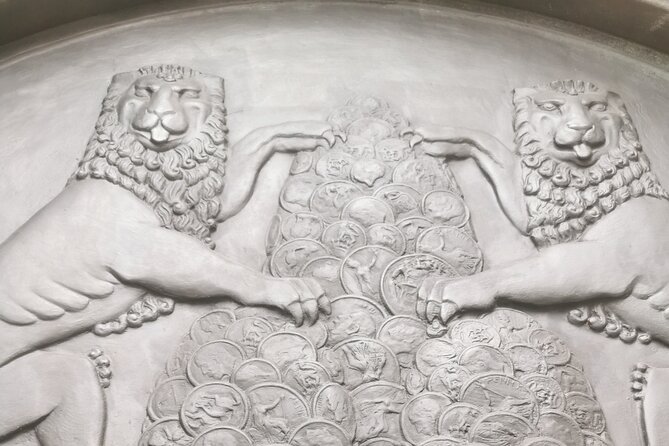
The final stop is the London Troops War Memorial on Cornhill. The memorial sits inside a circle of 12 dragon-shaped lamp posts representing the 12 great livery companies.
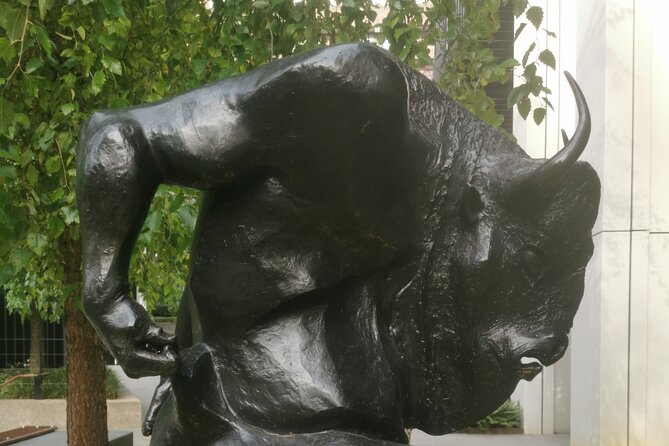
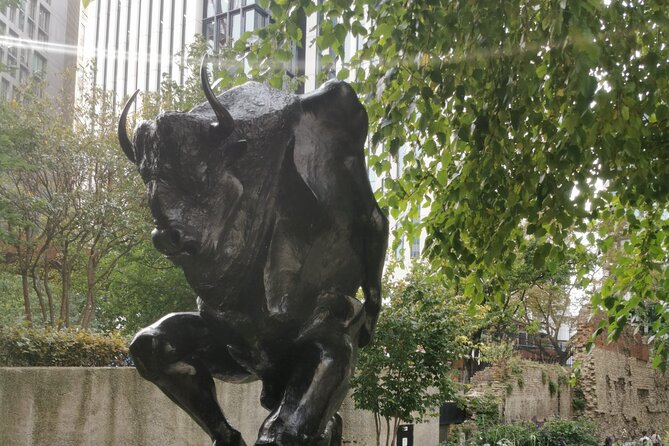
This is a strong place to finish because it brings together several themes from the walk. The dragons point to the livery companies, while the memorial points to service and sacrifice. The tour also highlights notable figures remembered in the area and returns to the story of the Minotaur.
The ending is near the Bank of England, at 1 Cornhill, rather than back at the Barbican. That matters for your plans. You can continue toward the financial district, reach nearby public transportation, or arrange your next London sight from the City rather than returning to the starting point.
The final 10 minutes are likely to feel more reflective than the opening. The walk begins with walls and forts, then moves through institutions and symbols before ending with remembrance.
Is $30.69 a fair price?
At $30.69 per person, this is a reasonable price for a 2-hour-25-minute guided walk, particularly if you value interpretation. You are paying for a carefully connected story across 15 stops, not for admission to a major ticketed attraction.
All listed stops have no admission charge, so the value rests on the guide’s explanations, route planning, and ability to connect details. That makes the small group especially important. With no more than eight people, the experience should feel more personal than a large city walk, and you have a better chance to ask about the City’s unusual customs and symbols.
I would book it if you like history, architecture, old institutions, and lesser-seen London. It is also a smart choice early in a London visit because it helps you understand the Square Mile before exploring it on your own.
You may want something else if your priority is entering several major attractions, spending long periods indoors, or seeing London’s royal and West End sights. This tour is about the City of London itself, not Buckingham Palace, Westminster Abbey, or the Tower of London.
The tour is offered in English and uses a mobile ticket. It is near public transportation, and most people can participate. It is also described as wheelchair and stroller accessible, which makes it a practical option for many visitors, though the listing does not give detailed information about individual surfaces or restroom access.
Free cancellation is available up to 24 hours before the start time. That is useful in London, where rain, fatigue, or a change in plans can quickly affect a day.
Who should book this City of London walk?
I would recommend it most strongly to:
- First-time London visitors who want a clear introduction to the Square Mile.
- History-focused people who enjoy Roman, medieval, religious, and civic subjects.
- Repeat visitors who have already seen the headline sights and want a less familiar route.
- Architecture fans interested in guild halls, churches, memorials, and financial institutions.
- Families using a stroller, or visitors who need an accessible option, since the experience is described as wheelchair and stroller accessible.
- Anyone who prefers a small group and a guide-led story to a self-guided walk.
The tour is less suited to you if you want free time at every stop or a fast-moving overview of all London. Its strength is the connections between places, and those connections need a little attention.
Should you book it?
Book this tour if you want to understand why London’s Square Mile still matters. For $30.69, you get a small-group walk through Roman defenses, medieval churches, livery company history, Guildhall, the Royal Exchange, Mansion House, the Bank of England, and a dragon-ringed war memorial.
The best reason to choose it is the offbeat route. Argun’s tour includes the famous institutions, but it also points out gardens, ruins, symbols, and civic details that are easy to overlook. Give it 2.5 hours, wear comfortable shoes, and arrive ready to listen. If that sounds like your kind of London, this is a strong-value history walk.
FAQ
How long does the City of London History Tour last?
The tour lasts approximately 2 hours and 30 minutes. The listed stop times add up to about 145 minutes.
How much does the tour cost?
The price is $30.69 per person.
Where does the tour begin?
The meeting point is Barbie Green, 2 London Wall Place, Barbican, London EC2Y 5AU, United Kingdom.
Where does the tour end?
The tour ends at the London Troops War Memorial, 1 Cornhill, London EC3V 3LN, United Kingdom, inside the circle of dragon lamp posts.
What language is the tour offered in?
The tour is offered in English.
How many people can join the tour?
The experience has a maximum of eight travelers.
Is the tour wheelchair and stroller accessible?
Yes. The experience is described as wheelchair and stroller accessible.
Can I cancel for a full refund?
Yes. You can cancel for a full refund if you cancel at least 24 hours before the experience start time. Changes or cancellations made less than 24 hours before the start time are not accepted for a refund.
Latest arrivals on the London list
- Easy Access Tower of London Royal Secrets & Scandals Tour★ 5.0 · 3 reviews
- Stonehenge Special Access Guided Morning Tour from London★ 4.5 · 3 reviews
- Shoreditch & East London Walking Tour with a Local, Custom & Private★ 5.0 · 3 reviews
- Madame Tussauds London Fast Track and Champagne Experience★ 3.5 · 3 reviews
- London Private Brixton Tour with a Local – Culture & Stories★ 4.9 · 3 reviews
- Private Full Day Tour – Fast Track Tower of London and Lunch★ 4.6 · 3 reviews
- Private transfer from London Heathrow Airport to Southampton★ 5.0 · 3 reviews
- The women of London★ 4.5 · 3 reviews
Historical Tours, compared.
Royal Historic Pubs Walking Guided Tour in London
Read our review →
Private Group: Historical Pub Walking Tour of London
Read our review →
Browse the lists this tour appears in