
Reviewed · JACK THE RIPPER TOURS
Private Jack the Ripper Walking Tour of Whitechapel and Brick Lane
Jack the Ripper’s 1888 crimes are still wrapped in fog, rumor, and bad information. This private walk cuts through much of that clutter as Jenny leads you from Aldgate into Whitechapel and Brick Lane, using period photographs and documents on a large backlit tablet.
I like the one-guide-to-one-group format, which lets you ask questions without losing your place in a crowd. I also like the clear link between famous crime sites and the streets around them, including pubs, markets, courtyards, and old church grounds. The main drawback is that the subject is grim, and the 2.5-hour walk requires moderate fitness, mostly on busy East London streets.
In This Review
- Key points to know before you book
- Why this private Whitechapel walk works
- Starting at St Botolph’s Aldgate and Aldgate Square
- Mitre Square and the night of the double event
- Petticoat Lane, Goulston Street, and a crucial clue
- Wentworth Street and the Martha Tabram case
- Brick Lane and Polly Nichols’s final drink
- Hanbury Street and the Annie Chapman murder
- Puma Court and the famous letters
- The Ten Bells and Christchurch graveyard
- The From Hell letter at the London Fruit and Wool Exchange
- Miller’s Court and the final stop at Mary Kelly’s site
- Price, group size, and what you receive
- Who should book this Whitechapel tour?
- Should you book it?
- FAQ
- How long is the Jack the Ripper walking tour?
- How many people can join at the basic price?
- Where does the tour start?
- Where does the tour end?
- Is food or bottled water included?
- What is the cancellation policy?
Key points to know before you book
- Jenny’s theatrical presentation: She may appear in Victorian dress and brings the period to life without relying only on spooky claims.
- A genuine private tour: The base price covers up to five people, so the value improves when shared by a small group.
- A useful visual aid: A 14-inch backlit tablet shows photos of victims, locations, suspects, and the famous letters.
- A strong East London route: You move from St Botolph’s Aldgate through Mitre Square, Petticoat Lane, Hanbury Street, Brick Lane, and the former site of Miller’s Court.
- A fact-and-theory approach: The walk covers what is known, what is disputed, and how the Ripper story grew.
- An evening-only experience: Tours are offered Monday through Thursday, from 3 PM to 9 PM, during the stated operating period.
Why this private Whitechapel walk works
The best part of a Jack the Ripper tour is not simply locating murder sites. It is understanding how a small area of London could contain sharp contrasts: wealthy commercial streets close to overcrowded lodging houses, markets beside dark passageways, and respectable civic buildings near places where poor women struggled to survive.
This route handles that contrast well. You begin at St Botolph’s Aldgate, then cross the old boundary between the City of London and the Metropolitan Police district. That line mattered in 1888, since different authorities controlled different parts of the area. The walk then moves through the streets connected with the victims and the investigation.
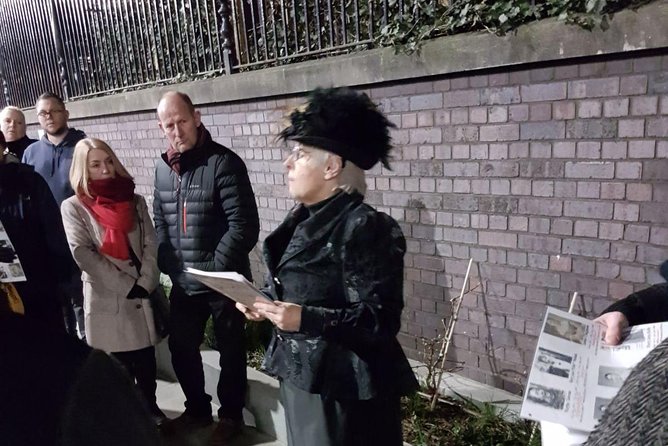
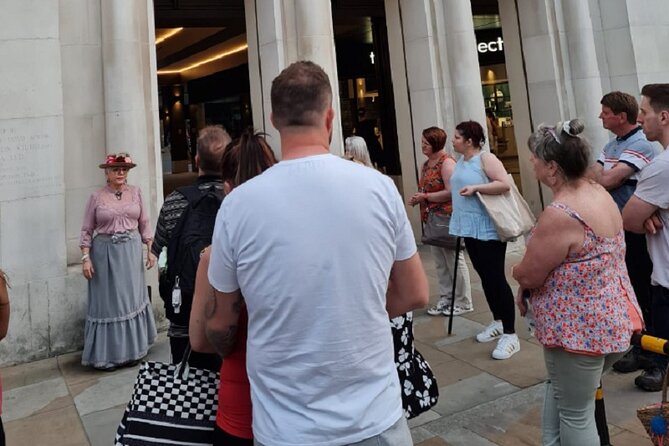
Jenny’s role is central. She has led walks in this area for decades, and her presentation combines local familiarity with a strong command of the case. The Victorian dress is a theatrical touch, but the tablet adds something more useful: you can compare today’s street with old photographs instead of trying to picture everything from words alone.
Because the tour is private, you can ask about a particular suspect, challenge a theory, or pause when a location needs more explanation. That makes a real difference here. A large group can easily turn a complicated story into a string of names and dates. With your own guide, you have more room to sort fact from folklore.
More Ripper walks in the East End:
- London: The Original Jack the Ripper Walking Tour
★ 4.7 · 7,833 reviews - London Jack the Ripper Guided Tour with Ripper-Vision
★ 4.5 · 4,840 reviews - London: Jack the Ripper Small Group Tour
★ 4.7 · 3,159 reviews
Starting at St Botolph’s Aldgate and Aldgate Square
The walk begins on Aldgate High Street near St Botolph’s Aldgate. This is a practical starting point because it places you at the edge of the old City of London, close to the streets where the story begins.
The first talk sets the scene in 1888. You will hear about the area as it was then, rather than treating Whitechapel as a ready-made horror set. The surroundings have changed greatly, so the old images on the tablet help you see the difference between the present street and the district the victims knew.
At Aldgate Square, Jenny explains the poverty that shaped daily life in Whitechapel. The focus includes workhouses and common lodging houses, where many people lived with little privacy or security. This section matters because it gives the crimes a social setting. The story is not only about an unknown killer. It is also about women who lived close to the edge and often received little protection.
The first two stops are short, but they give you the tools needed for the rest of the walk. You begin to understand why the same streets could serve as workplaces, sleeping quarters, drinking places, and routes home.
Mitre Square and the night of the double event
At Mitre Square in the City of London, the story turns to Elizabeth Stride and Catherine Eddowes. Their murders took place on September 30, 1888, a night often called the double event.
This stop lasts about 20 minutes, making it one of the longer and more important sections of the walk. Jenny explains the sequence of events and the reasons the two crimes have been linked. The square also allows her to discuss the boundary between the City and Metropolitan areas, which becomes important when considering police jurisdiction and the investigation.
The tablet is especially useful here. A location can look ordinary now, and that can make it hard to grasp why it mattered. Period photographs and images of the people involved add a human face to names that are often reduced to case notes.
The tone is serious rather than playful. That is welcome. A Ripper tour can easily turn suffering into costume drama, so I appreciate the effort to show the victims as real people while still explaining the theories that keep the case alive.
Petticoat Lane, Goulston Street, and a crucial clue
The walk continues toward Petticoat Lane Market, now called Middlesex Street. This section marks the boundary between the City of London and the Metropolitan area, giving you another chance to see how policing and geography overlapped.
The stop itself is brief, but the nearby doorway at 118 to 119 Goulston Street carries more weight. A piece of apron belonging to Catherine Eddowes was found there, along with graffiti on the doorpost. Jenny examines the clue and the arguments around it, helping you understand why a small piece of evidence can produce so many different interpretations.
This is one of the places where the private format pays off. You can ask whether the graffiti was connected to the killer, how the police treated it, and what later writers have added to the story. The exact meaning remains disputed, so expect competing views rather than a tidy solution.
You also get a feel for how close these locations are. On a map, the case can seem spread across East London. On foot, the connections become clearer, though you should remember that modern roads, buildings, and traffic have altered the setting.
More East End and Shoreditch walks:
- Jack The Ripper Tour in London’s East End
★ 4.5 · 718 reviews - Shoreditch Street Art Tour London
★ 5.0 · 481 reviews - Gangster Tour of London’s East End Led by Actor Vas Blackwood
★ 5.0 · 389 reviews - London: East End Street Art Tour and Spray Painting Workshop
★ 4.8 · 297 reviews
Wentworth Street and the Martha Tabram case
At Wentworth Street, the focus shifts to Martha Tabram. She is now often considered a possible first victim of Jack the Ripper, though her place in the case remains uncertain.
The route then reaches Gunthorpe Street, where George Yard Buildings once stood and where Tabram was murdered. The stop is short, about two minutes, but it adds an important layer to the usual five-victim narrative. You are not confined to the most familiar version of the story.
This part of the tour is useful for anyone who has read about the case before. It shows how the accepted list of victims depends on patterns, police records, later theories, and disputed evidence. Jenny presents those connections without pretending that every question has been settled.
Brick Lane and Polly Nichols’s final drink
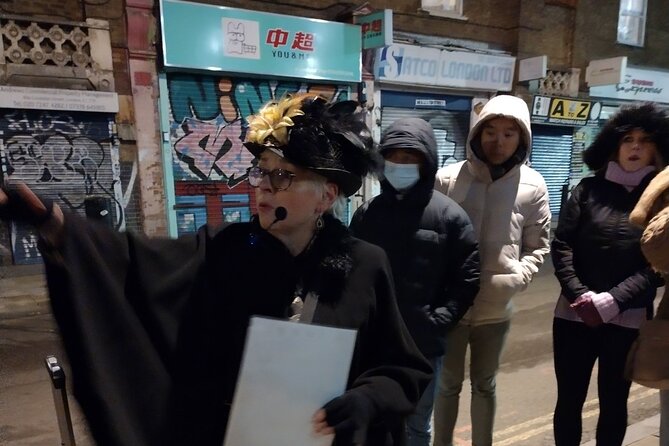
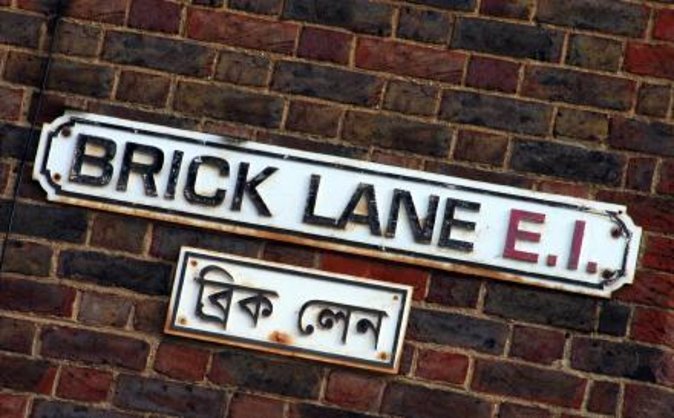
Brick Lane brings a change of mood. It is one of East London’s best-known streets today, but the tour uses it to look back at the places connected with the victims.
Opposite the Frying Pan Pub, you hear about Mary Anne Nichols, commonly called Polly, and the last drink she had there. The stop lasts about ten minutes. That detail makes the final hours of her life feel close and specific, rather than distant and abstract.
Brick Lane is also a good reminder that the neighborhood is not frozen in 1888. You may find shops, food places, and present-day activity around you while listening to a story from another era. That contrast can be powerful, though it also means this is not a silent ghost walk. Expect an active urban setting, not an empty Victorian street.
Hanbury Street and the Annie Chapman murder

At Hanbury Street, Jenny discusses the murder of Annie Chapman in the backyard of number 29. This is another major stop, with around ten minutes devoted to the site and the surrounding evidence.
The tablet helps here by showing the location as it appeared in the period. You can better understand the layout of the house, yard, and nearby streets when the explanation is paired with an image. Jenny also uses photographs and articles to clarify who was involved and what investigators knew at the time.
This stop can be disturbing. The tour deals with real violence, not a fictional mystery, and the material may not suit younger children or anyone looking for light entertainment. The suggested minimum age is 12 and above, which feels sensible.
Puma Court and the famous letters
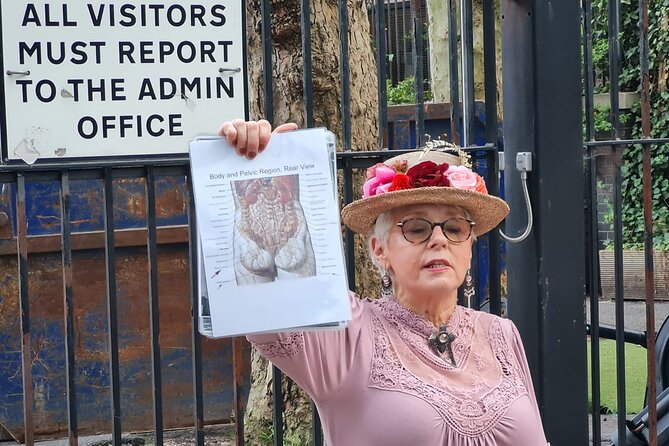
Puma Court provides a narrower, more enclosed setting. Here, the discussion turns to the Dear Boss letter sent to the Central News Office.
The letter helped shape the public image of Jack the Ripper, including the name by which the killer became famous. Jenny examines the document and its place in the case, rather than treating it as unquestioned proof of authorship.
This is a good moment to ask about the difference between evidence from 1888 and the legend created afterward. Letters, newspapers, police rumors, and public fear all fed into the Ripper story. Some material may have come from the killer, while some may have been hoaxes or publicity efforts. The tour gives you space to consider those possibilities.
The courtway also shows why walking is the right way to study this subject. You move through spaces that connect one major street to another, seeing how quickly the character of the area could change.
The Ten Bells and Christchurch graveyard
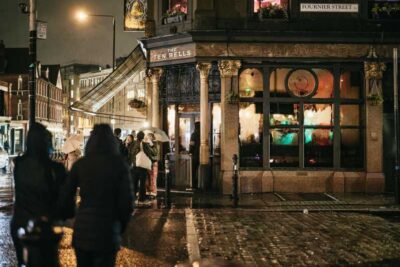
Near The Ten Bells, the walk covers Mary Kelly’s favorite pub and Christchurch graveyard. The area was also associated with homeless women who gathered there during the day.
The pub is one of the most famous landmarks in the Ripper story, but the tour does not treat it as a simple memorial. Jenny places it within the lives of women who worked, drank, rested, and looked for company in a hard neighborhood.
This stop lasts about eight minutes. It is a useful point to pause and consider how much of the modern Ripper image comes from later storytelling. Pubs and streets can become symbols, but the people linked to them lived ordinary, difficult lives before they were absorbed into crime history.
You may also find this one of the more crowded parts of the route, depending on the time and day. The private group makes it easier to hear and stay together, but you should still wear shoes suited to city walking.
The From Hell letter at the London Fruit and Wool Exchange
The route reaches the London Fruit and Wool Exchange, where Jenny examines the From Hell letter sent to George Lusk of the Whitechapel Vigilance Society.
The discussion takes place in a passage leading to the central courtyard. Again, the tablet lets you see the document and related images in a clear format. A 14-inch backlit screen is a practical choice for an evening walk, especially when printed photos would be hard to read.
This part of the tour shows how citizens responded to fear in the neighborhood. George Lusk and the Whitechapel Vigilance Society were part of the local effort to watch the streets and react to the murders. The letter brings together the killer’s claimed voice, public anxiety, and the limits of Victorian policing.
The setting also underlines a simple truth: buildings change, but street patterns and passageways can preserve a sense of connection. You are not seeing every 1888 structure intact, yet the route still helps you place the events within the working district of East London.
Miller’s Court and the final stop at Mary Kelly’s site
The tour ends in the courtyard of the London Fruit and Wool Exchange, at the former site of Miller’s Court on Dorset Street. This is where Jenny discusses Mary Kelly, usually regarded as the last victim associated with Jack the Ripper.
The final stop lasts about 20 minutes and brings together several threads from the walk. You hear about Kelly’s murder, the evidence connected with it, and some of the men suspected over the years. Since the exact identity of the killer remains unknown, this is a natural place to compare the leading theories and decide how much weight each one deserves.
The end point is about a five-minute walk from Liverpool Street Station. That makes the finish convenient for returning to central London or continuing your evening elsewhere. The walk does not include food or bottled water, so bring your own water and plan dinner separately.
Price, group size, and what you receive
The listed price is $205.76 per group of up to five people. The tour information also gives a basic price of £150 for five people, with an additional £25 per person beyond that group size. Since the quoted amount can vary by booking currency and date, check the final price before paying.
For five people, the cost works out to roughly $41 per person at the stated dollar price. That is fair for a 2.5-hour private tour, particularly if you value questions, a flexible pace, and direct time with Jenny. For one or two people, the per-person cost is much higher than a standard group walk, so the private format is the main value rather than a low price.
You receive the guided walk and the photo material shown on the backlit tablet. Food and drink are not included. The route is near public transportation, begins on Aldgate High Street, and ends near Liverpool Street Station, which helps you fit it into an evening schedule.
Free cancellation is available up to 24 hours before the start time. Changes or cancellations made less than 24 hours ahead are not accepted for a refund.
Who should book this Whitechapel tour?
I would choose this walk if you already have an interest in the Ripper case and want more than a quick list of murder sites. Jenny’s long experience, Victorian presentation, and use of visual material make it a good fit for visitors who enjoy detail and discussion.
It also suits a small family group with older children, since the suggested minimum age is 12. Parents should be comfortable with the subject matter. This is a story of poverty, murder, and exploitation, not a harmless spooky stroll.
You need moderate physical fitness. The route lasts about two and a half hours and moves through city streets, markets, courtyards, and passageways. Wear comfortable shoes and bring water, especially if you are booking the later time slot.
The experience is offered in English and is scheduled Monday through Thursday from 3 PM to 9 PM during the stated operating dates. If your London plans center on Friday or the weekend, this particular schedule may not fit.
Should you book it?
Book this private Jack the Ripper walk if you want a focused East London tour led by a guide who can answer questions and separate documented facts from later theories. Jenny’s strongest assets are her long local experience, lively period presentation, and the clear visual material she carries with her.
Skip it if you dislike true crime, prefer a short sightseeing walk, or want a low-cost group activity. The price makes the most sense for up to five people sharing the booking. For that kind of small group, the route offers a thoughtful look at Whitechapel, the victims, the investigation, and the neighborhood beyond the legend.
FAQ
How long is the Jack the Ripper walking tour?
The tour lasts approximately 2 hours and 30 minutes.
How many people can join at the basic price?
The basic private tour price covers up to five people. Additional people cost £25 per person according to the tour details.
Where does the tour start?
The meeting point is on Aldgate High Street, London EC3N 1AH, near St Botolph’s Aldgate.
Where does the tour end?
The tour ends at Bell Lane in East London, in the courtyard area of the London Fruit and Wool Exchange. It is about a five-minute walk from Liverpool Street Station.
Is food or bottled water included?
No. Food, drink, and bottled water are not provided.
What is the cancellation policy?
You can cancel up to 24 hours before the experience start time for a full refund. Cancellations or changes made less than 24 hours before the start time are not accepted.
More London walking tours
- Magical London: Harry Potter Guided Walking Tour
★ 4.7 · 22,044 reviews - Tour for Muggles The Ultimate Harry Potter Walking Tour in London
★ 5.0 · 4,684 reviews - London Jack The Ripper Guided Walking Tour
★ 5.0 · 3,131 reviews - London: Harry Potter Movies Walking Tour (Kids Go Free)
★ 4.7 · 3,071 reviews
Latest arrivals on the London list
- Easy Access Tower of London Royal Secrets & Scandals Tour★ 5.0 · 3 reviews
- Stonehenge Special Access Guided Morning Tour from London★ 4.5 · 3 reviews
- Shoreditch & East London Walking Tour with a Local, Custom & Private★ 5.0 · 3 reviews
- Madame Tussauds London Fast Track and Champagne Experience★ 3.5 · 3 reviews
- London Private Brixton Tour with a Local – Culture & Stories★ 4.9 · 3 reviews
- Private Full Day Tour – Fast Track Tower of London and Lunch★ 4.6 · 3 reviews
- Private transfer from London Heathrow Airport to Southampton★ 5.0 · 3 reviews
- London Soho District – Guided Walking Tour 12 guests 2,5h★ 4.8 · 3 reviews
Jack the Ripper Tours, compared.
London Jack the Ripper Guided Tour with Ripper-Vision
Read our review →
German Language : Original Jack the Ripper Tour
Read our review →
Jack the Ripper Walking Tour – Ripper Vision Tours
Read our review →
Ultimate Jack the Ripper : Guided Tour of London
Read our review →
Browse the lists this tour appears in