
Reviewed · COVENT GARDEN & WEST END TOURS
Private Tour: Photography Walking Tour from Trafalgar Square to Covent Garden
London becomes your classroom on this private photo walk from Trafalgar Square to Neal’s Yard. With Fine Art photographer Lou Smith, you move through grand squares, Chinatown lanes, Covent Garden, and colorful Neal’s Yard while learning how to make stronger pictures with the camera you already own.
I especially like the one-to-one teaching and the way the route mixes famous sights with small side streets. I also like the practical photo review over a coffee or snack, where you can see what worked and what you could try next.
The main drawback is the price: $347.77 per person is a serious outlay for a four-hour walk, particularly for one or two people. It makes more sense if you care about improving your photography and can share the private experience with a larger personal group.
In This Review
- Key points to know before booking
- A photo lesson that uses London well
- Trafalgar Square: statues, fountains, and open views
- Leicester Square: small changes in light and angle
- Chinatown: color, detail, and side streets
- Covent Garden: architecture and movement
- Neal’s Yard: a compact final lesson
- What the teaching is really worth
- Who should book this London photo walk?
- Booking and cancellation details
- Should you book it?
- FAQ
- How long does the photography walking tour last?
- Where does the tour start and finish?
- What locations does the tour visit?
- Do I need a professional camera?
- What should I bring?
- Is the tour suitable for beginners?
Key points to know before booking
- Trafalgar Square to Neal’s Yard: A four-hour route links major London sights with Chinatown streets and colorful courtyards.
- Private instruction with Lou Smith: The tour is adjusted to your camera, experience, and photographic goals.
- Useful camera practice: Work on aperture, depth of field, shutter speed, focus modes, light, color, framing, and composition.
- A real photo review: Stop for refreshments at your own expense and examine selected images with your guide.
- Bring any digital camera: The session suits digital cameras and smartphones, but you should bring a fully charged battery and extra memory cards.
- All-weather walking: The tour operates in all weather, so comfortable clothing and sensible rain protection matter.
A photo lesson that uses London well
Many city tours point you toward a landmark, allow a few minutes for pictures, and move on. This experience takes a different approach. London supplies the subjects, but the real focus is learning how to see and use your camera.
You spend about four hours walking at a relaxed pace between Trafalgar Square and Neal’s Yard. The route is private, so Lou can adjust the session to your level. A beginner can learn the main controls without feeling rushed, while an experienced photographer can work on composition, unusual angles, or more deliberate use of light.
That private format matters. You are not waiting for a group to finish taking the same picture. You can spend longer at a subject that interests you, ask about a particular camera menu, or change direction when the light or street activity gives you something worth photographing.
The teaching also appears practical rather than purely technical. You learn a camera setting, then use it on a statue, building, shopfront, or moving street performer. That connection between instruction and subject is one of the strongest reasons to consider the tour.
More Covent Garden and West End walks:
- London West End Musical Silent Disco Walking Tour Top 1% Rated
★ 5.0 · 1,057 reviews - Pasta Making with Unlimited Prosecco in London’s West End
★ 5.0 · 264 reviews - London: Burlesque Cabaret Show in the West End
★ 4.2 · 127 reviews
Trafalgar Square: statues, fountains, and open views
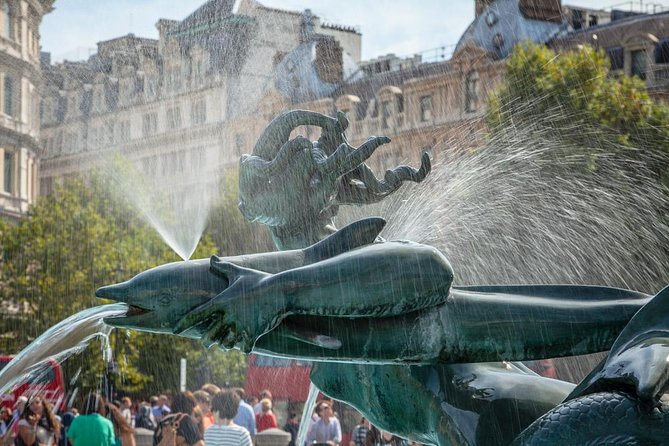
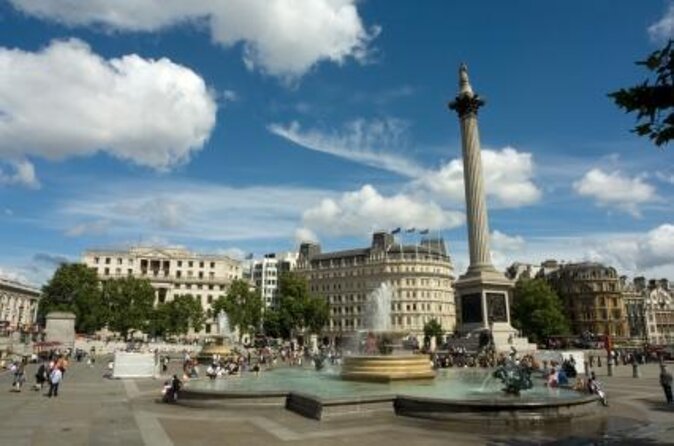
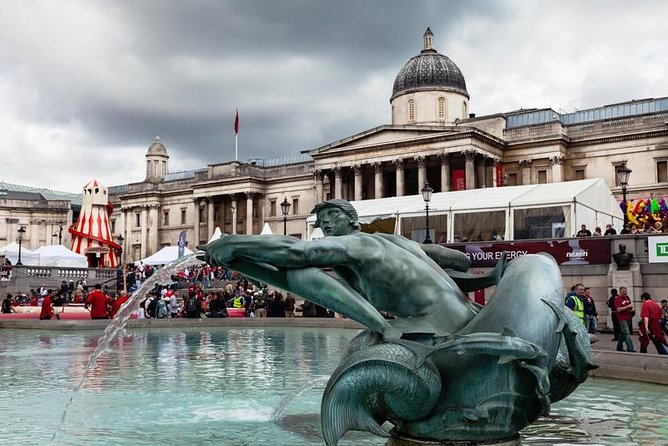
The tour begins near Charing Cross and heads into Trafalgar Square, one of London’s most useful places for an opening photography lesson. The square gives you several kinds of subjects at once: the Landseer Lions, fountains, monuments, statues, the National Gallery, pavement artists, and street entertainers.
This variety lets you start with basic choices about framing. You might work out how much sky to include above a monument, how to use the fountains as foreground interest, or how to place a statue against the surrounding architecture. The broad view toward Whitehall also gives you room to practice distance and scale.
Lou introduces aperture, depth of field, and light here. Those terms can sound abstract in a manual, but the square gives you clear ways to test them. A wide aperture can help separate a statue or performer from the background. A smaller aperture can keep more of the scene sharp when you want the square and its buildings to share attention.
The street performers and pavement artists add a useful human element. They also bring a practical challenge: people move, scenes change, and you must decide quickly. If you prefer carefully arranged architectural photographs, this first section still gives you plenty to work with. If you want to try street photography, it is a gentle place to begin.
The free admission is not the important saving here. The value comes from having someone explain why one angle or exposure may work better than another. You are paying for guided practice in a public setting, not entry to an attraction.
Leicester Square: small changes in light and angle
From Trafalgar Square, you walk to Leicester Square at an easy pace. This section lasts about 45 minutes and shifts the emphasis toward gardens, fountains, and sculpture.
The statue of William Shakespeare provides a straightforward subject for studying light and viewpoint. You can make several images from different angles and compare how the background, shadows, and surrounding space change the result. A statue of Charlie Chaplin offers another chance to work with aperture and depth of field.
This is a good point to pause and look at what you have taken. Refreshments are not included, but you take a short break at your own expense while reviewing your photographs with Lou. That review is valuable because it moves the lesson beyond taking pictures. You begin to recognize why one frame feels clearer, more balanced, or more interesting than another.
The stop may feel less distinctive than Chinatown or Neal’s Yard. Leicester Square is a popular central London spot, and the subjects here are familiar. Still, that familiarity can help. You can concentrate on technique rather than trying to find a rare subject.
I would especially value this pause if you have recently bought a digital camera. One detailed experience describes using a new camera with a large number of menus and settings. Lou helped make the important controls easier to use, then compared different compositions and ways of looking at the same object. That kind of help can save you from spending the rest of your trip relying on automatic mode.
Chinatown: color, detail, and side streets
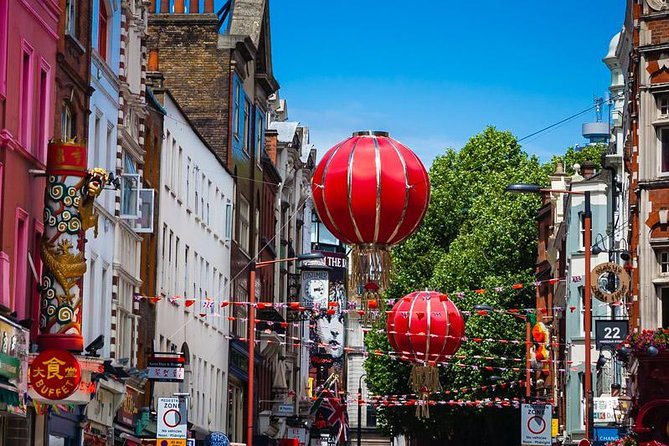
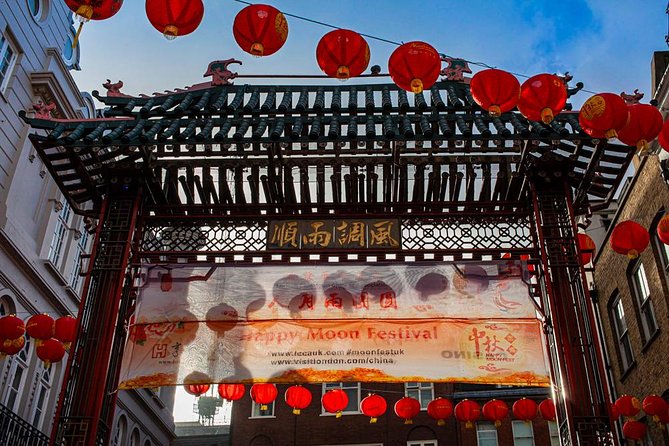
The route then turns into Chinatown, where the photography changes character. The monumental entrance gate is an obvious first picture, but it is only the beginning.
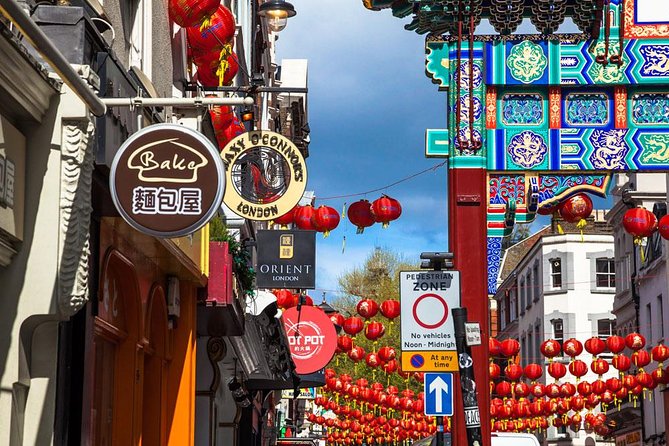
You work with colorful shopfronts, food displays, lanterns, stalls, and smaller side streets. Chinatown gives you strong blocks of color and plenty of close-up detail. It is well suited to lessons about depth of field because you can choose between a single sign, object, or decorative detail and the wider street behind it.
Color is the main lesson here. You learn how to use it deliberately rather than simply recording everything in front of you. A bright shopfront may become the subject, while nearby signs and decorations provide supporting color. You can also look for contrast, repeated shapes, and small details that would be easy to miss while walking through the area.
The side streets are important. The route is not limited to the main gate and the most obvious views. Lou guides you toward different viewpoints and encourages you to photograph the cultural character of the area in your own way.
This stop lasts about an hour, making it one of the longer parts of the walk. That gives you time to slow down and experiment. You can try the same subject with different apertures, shift your focus point, or change your position instead of accepting the first available view.
The limitation is that Chinatown can supply more visual material than you can comfortably process in one session. If you get absorbed in signs, food displays, and small details, you may need to trust Lou’s guidance on when to move on. The private format helps because the pace can be adjusted to your interests.
A few more London days worth a look
- London: Private Photoshoot with Video Clip Option
★ 4.8 · 182 reviews - Professional Photoshoot in London Photographer
★ 5.0 · 102 reviews - Private landmarks photoshoot for families and couples
★ 5.0 · 92 reviews - London: Private Landmark Tour with Professional Photographer
★ 4.7 · 91 reviews
Covent Garden: architecture and movement

Covent Garden brings together several different photography problems. You explore the Royal Opera House, the Apple Market, pedestrian areas, street entertainers, artisan stalls, cafes, bars, pubs, and small shops.
The street performers are a chance to use different shutter speeds and focus modes. A faster shutter speed can help freeze movement. A slower speed can show motion, though the result depends on how the subject and camera move. Lou can help you test these choices rather than leaving you to guess from the camera screen.
The performers also make you think about timing and focus. You need to anticipate an action, place your focus carefully, and make the picture before the moment disappears. That is more demanding than photographing a stationary monument, but it is useful practice for any city trip.
Architecture presents a different challenge. The Royal Opera House and Apple Market invite you to consider lines, symmetry, perspective, and the effect of shooting from above or below. Lou encourages different angles of view, helping you avoid the standard straight-on record shot.
The Apple Market also brings in design and color. Its historic structure, stalls, displays, and surrounding shops can make a strong subject, but the scene may contain too much information. Composition becomes a way to simplify what you see. You might isolate one stall, use a frame within the market, or let repeating shapes guide the eye.
Covent Garden is a social and commercial area, so you should expect plenty of visual activity. That is useful for practice, but it may not suit someone seeking a quiet walk focused only on buildings. The guide’s presence is particularly helpful here because you can ask how to make a clear image from a complicated scene.
Neal’s Yard: a compact final lesson
The walk ends at Neal’s Yard, a small courtyard area known for colorful walls and shopfronts. After the larger spaces of Trafalgar Square and Covent Garden, this is a more intimate place to finish.
The lesson here centers on composition and framing. The courtyard gives you a chance to decide how much of the surroundings belongs in the image. You can work with blocks of color, tight details, doorways, signs, and the relationship between the walls and the small space.
Neal’s Yard is also a useful final test because it asks you to apply several ideas from earlier in the tour. You may consider light, color, depth of field, and viewpoint in a single frame. Instead of simply collecting another famous London picture, you are asked to capture the feel of the place.
The stop lasts about 30 minutes. That is enough time for a final set of photographs, though not enough for an extended architectural study. It works best as a compact closing exercise rather than a separate major attraction.
What the teaching is really worth
At $347.77 per person, the price needs careful thought. You are not buying a standard sightseeing walk with a short photography talk. You are paying for a private session with a Fine Art photographer who has taught many people, understands a wide range of cameras, and reviews your work during the experience.
For a complete beginner, the value may come from learning the basic settings and gaining confidence with a new digital camera. For someone returning to photography after years away, the benefit may be reconnecting with manual controls, composition, and the pleasure of choosing a picture deliberately.
More experienced photographers may find the tour worthwhile if they want fresh ideas for photographing London. The instruction includes positive and negative space, close-up and wider views, color, framing, different perspectives, shutter speeds, focus modes, and aperture. You should not expect a formal advanced course in every one of these subjects during four hours, but you can ask Lou to focus on the areas that matter most to you.
The private arrangement also changes the value calculation. A solo booking is expensive, but the cost may make more sense for a personal group that shares the session. Group discounts are available, though the exact amount is not provided, so check the total before booking.
The strongest part of the teaching is the image review. During the break, you select photographs and discuss what worked, what did not, and what other compositions might have been possible. Lou can compare your images with her own examples, which helps you see how a small change in angle, framing, or use of space affects the final picture.
Who should book this London photo walk?
I would suggest it first to people who want to improve rather than simply collect sightseeing pictures. It suits:
- Beginners using a digital camera or smartphone
- People returning to photography after a long break
- Couples or private groups with different skill levels
- Photographers who want help with street scenes and architecture
- Visitors who want a central London orientation while practicing photography
- Anyone carrying a new camera and unsure which settings matter most
You should bring your own camera, a fully charged battery, and extra memory cards. Four hours of practice can produce a large number of images, especially when you are testing several settings on the same subject.
Smartphones are suitable, as are all types of digital cameras. You do not need to own a professional camera to take part. The minimum age is 16, and service animals are allowed.
This is a walking experience, so wear comfortable clothing and prepare for London weather. It operates in all conditions. The route is near public transport, starts at Charing Cross, and finishes at Neal’s Yard. Lunch and refreshments are not included, so budget for your own break.
Booking and cancellation details
Confirmation is provided when you book. The activity is offered in English and is exclusive to your group.
Free cancellation is available if you cancel at least 24 hours before the start time. Changes or cancellations made less than 24 hours before the start time are not accepted for a refund. The cut-off follows London local time.
Should you book it?
Book this tour if you want personal instruction tied to real London subjects. Lou Smith’s approach is particularly useful when you need help with camera controls, composition, and making decisions in the moment. The route offers a good progression: open views and monuments at Trafalgar Square, sculpture and light in Leicester Square, color in Chinatown, movement and architecture in Covent Garden, and close composition at Neal’s Yard.
Skip it if you mainly want a cheap guided walk or a quick introduction to London landmarks. The $347.77 per-person price is high for sightseeing alone. But if you treat the four hours as a private photography workshop, bring a camera you want to understand, and make full use of the image review, the experience offers a more personal kind of value.
FAQ
How long does the photography walking tour last?
The tour lasts approximately four hours.
Where does the tour start and finish?
It starts at Charing Cross, Strand, London WC2N 5HF, and ends at Neal’s Yard, London WC2H.
What locations does the tour visit?
The route includes Trafalgar Square, Leicester Square, Chinatown, Covent Garden, and Neal’s Yard.
Do I need a professional camera?
No. The tour is suitable for all digital cameras, including smartphones.
What should I bring?
Bring your own camera, a fully charged battery, and additional memory cards for the photographs you take. Dress appropriately because the tour operates in all weather conditions.
Is the tour suitable for beginners?
Yes. It is suitable for all skill levels, and the private format allows the instruction to be tailored to your experience and needs.
More London walking tours
- Magical London: Harry Potter Guided Walking Tour
★ 4.7 · 22,044 reviews - London: The Original Jack the Ripper Walking Tour
★ 4.7 · 7,833 reviews - Tour for Muggles The Ultimate Harry Potter Walking Tour in London
★ 5.0 · 4,684 reviews - London Jack The Ripper Guided Walking Tour
★ 5.0 · 3,131 reviews
Latest arrivals on the London list
- Easy Access Tower of London Royal Secrets & Scandals Tour★ 5.0 · 3 reviews
- Stonehenge Special Access Guided Morning Tour from London★ 4.5 · 3 reviews
- Shoreditch & East London Walking Tour with a Local, Custom & Private★ 5.0 · 3 reviews
- Madame Tussauds London Fast Track and Champagne Experience★ 3.5 · 3 reviews
- Private Full Day Tour – Fast Track Tower of London and Lunch★ 4.6 · 3 reviews
- Private transfer from London Heathrow Airport to Southampton★ 5.0 · 3 reviews
- London Private Brixton Tour with a Local – Culture & Stories★ 4.9 · 3 reviews
- London Soho District – Guided Walking Tour 12 guests 2,5h★ 4.8 · 3 reviews
Covent Garden & West End Tours, compared.
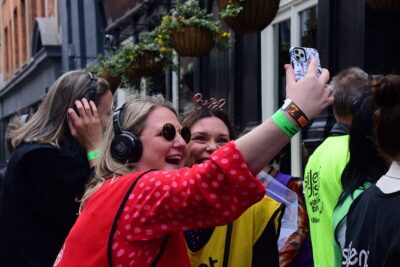
London West End Musical Silent Disco Walking Tour Top 1% Rated
Read our review →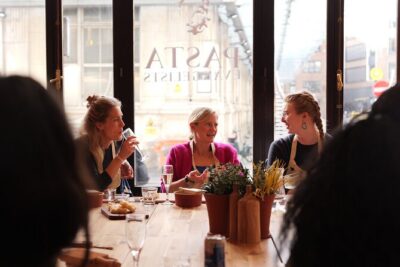
Pasta Making with Unlimited Prosecco in London’s West End
Read our review →

International Stand Up Comedy Show in Covent Garden
Read our review →
London West End Musical Silent Disco Walking Tour Top 1%
Read our review →
Kid-Friendly Private British Museum Highlights and Walk to Covent Garden London
Read our review →
Browse the lists this tour appears in