
Reviewed · EAST END & SHOREDITCH TOURS
East End London Instagrammable Street Art and Graffiti Tour
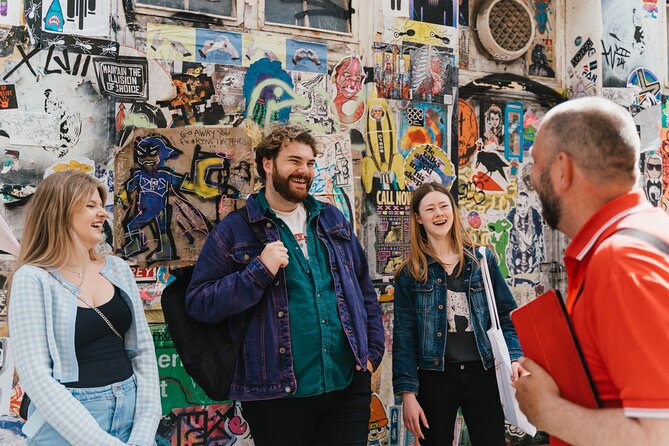
East London’s art is not displayed behind museum glass. It covers doors, back walls, shutters, yards, and whole sides of buildings. On this two-hour walking tour, you follow a local guide from Whitechapel through Brick Lane and Shoreditch, spotting famous names such as Banksy, Stik, ROA, and Ben Eine along the way.
I like the mix of large murals and tiny works that you could easily miss on your own. I also like that the guide explains the local stories behind the paint, from refugee communities to old graffiti rivalries, then gives you a chance to make your own street art. The main drawback is the brisk pace: with 17 stops in about two hours, several locations receive only five minutes.
In This Review
- Key points at a glance
- Why this East London walk is different
- Heneage Street begins with giant hidden walls
- Brick Lane rewards a closer look
- Stickers, Stik, and local meaning
- Hanbury Street has some of the route’s biggest images
- Broccoli Lane and the art of repetition
- Allen’s Gardens shows graffiti in constant motion
- Ebor Street shifts from rough to polished
- Banksy, glass panels, and a useful art debate
- Colorful faces and a preserved piece of wall
- Shakespeare, Romeo and Juliet, and a wall of many styles
- Graffiti Wars lead toward Liverpool Street
- Practical details that affect your day
- Who should book this East London art walk?
- Should you book it?
- FAQ
- How long does the East End street-art tour last?
- Where does the tour begin?
- What time does the tour start?
- Where does the tour finish?
- How much does the tour cost?
- Is admission to the street-art locations included?
- Will I see Banksy artwork?
- How many people can join the tour?
- Is the tour close to public transportation?
- Can I cancel for a refund?
Key points at a glance
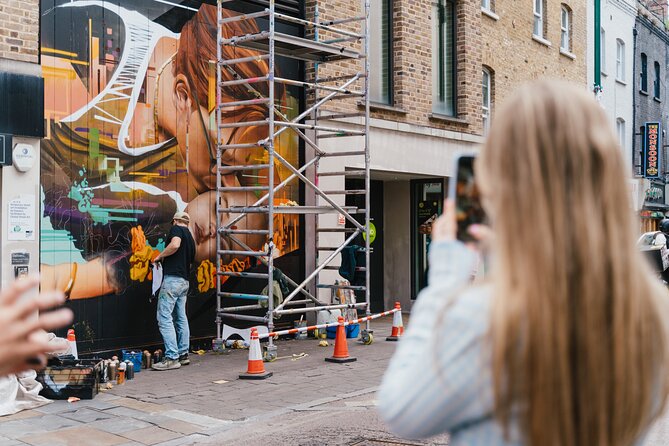
- Banksy and beyond: See preserved Banksy pieces, including an artwork displayed at art’otel London Hoxton, plus work by major artists from London and Europe.
- A real walking route: Start at 80 Whitechapel High Street and finish within walking distance of Liverpool Street Station.
- Art that keeps changing: Allen’s Gardens and several Brick Lane walls may look different from one visit to the next.
- Stories behind the paint: Learn about Shoreditch’s Muslim community, immigrant neighborhoods, graffiti writers, and the famous Graffiti Wars.
- Hands-on finish: You do not just look at street art. You also get the chance to create a piece yourself.
- Small-group setting: The group is limited to 20 people, useful in narrow yards and busy streets.
Why this East London walk is different
This is not simply a tour of colorful walls. It is a lesson in how public art works when the city itself becomes the gallery. Some pieces are polished murals. Others are stickers, slogans, tags, stencils, or letters so tangled that you may never work out what they say.
That variety is the point. You see how different artists claim space and how quickly the neighborhood changes. A wall that looks permanent may be painted over within days. Another piece may survive for 20 years, becoming almost ancient by graffiti standards.
The route begins at 11:00 a.m. at 80 Whitechapel High Street. From there, you walk west and north through East London, ending near Liverpool Street Station. The route is practical if you are already exploring the East End, and it puts you close to the City afterward.
At $49 per person, the cost is reasonable if you want interpretation rather than a self-guided photo walk. You could see many of these streets for free, but you would likely miss the small yards, artists’ signatures, and local stories. The value rests on the guide’s ability to point out what is easy to overlook.
More East End and Shoreditch walks:
- Jack The Ripper Tour in London’s East End
★ 4.5 · 718 reviews - Shoreditch Street Art Tour London
★ 5.0 · 481 reviews - Gangster Tour of London’s East End Led by Actor Vas Blackwood
★ 5.0 · 389 reviews
Heneage Street begins with giant hidden walls
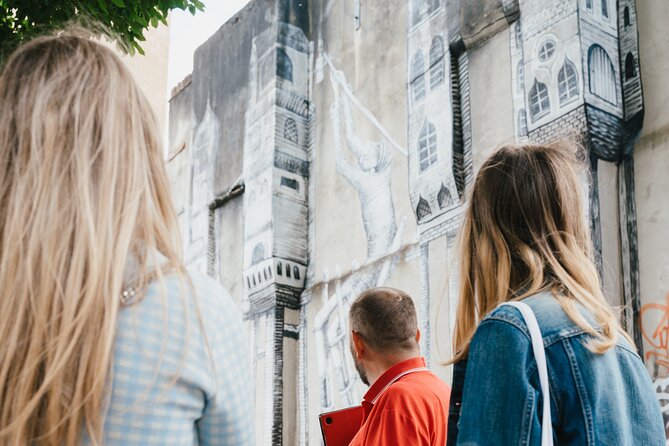
The first stop, Heneage Street, sets the tone. Two huge works sit away from the main road in small backyards, each taking up much of a building wall.
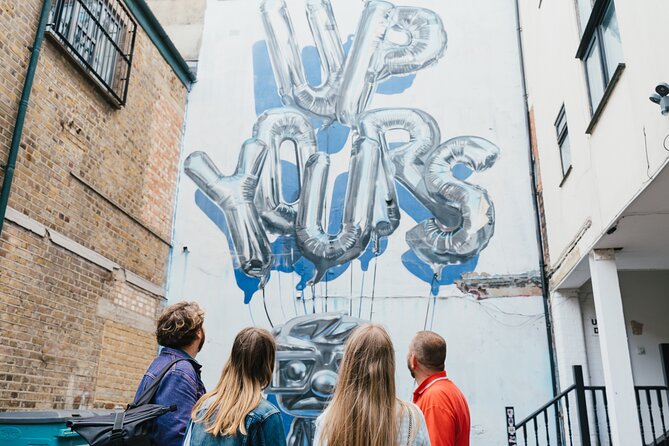
Phlegm’s piece features his familiar thin, long creatures walking on stilts above layers of tags. Across the street, FanakaPan uses silver helium balloons as the basis for a playful, animated image. The advice here is simple: look up. The best details are not always at eye level.
You spend about ten minutes here, which is enough to study the scale and take photographs. The tucked-away setting also shows why this tour helps. These walls are easy to pass without knowing they are there.
Brick Lane rewards a closer look
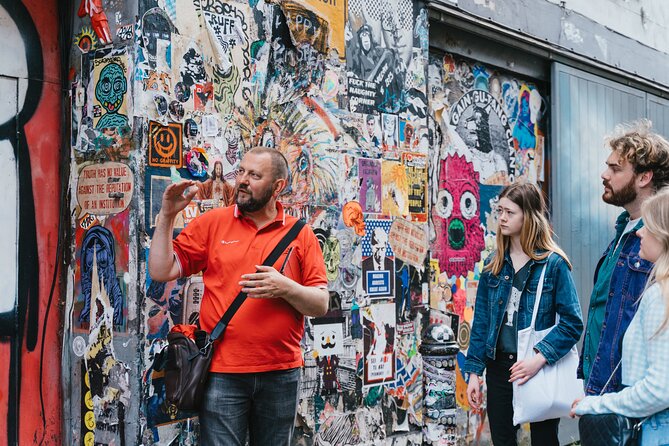
Brick Lane is the heart of the route, but the tour does not treat it as one long photo stop. At one point, the guide asks you to view works by Dan Kitchener and Perspicere from a distance, then move closer.
That change in position matters. Their works are painted on doors rather than giant walls, so the technical details appear only when you step forward. You learn to look for surface, line, and tiny choices rather than judging a piece from across the street.
Brick Lane can feel crowded and visually noisy, so the five-minute stop is short. You will not linger over every image. Instead, you get a quick lesson in how to read smaller street art.
Stickers, Stik, and local meaning
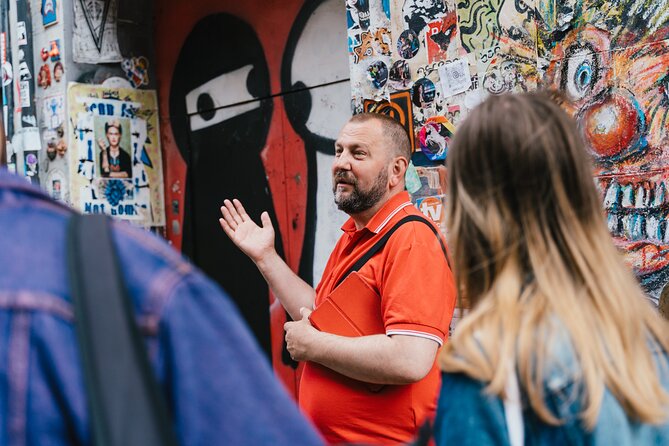
At The Seven Stars, the art moves from paint to stickers. A narrow, dirty yard may not look inviting at first, but it is packed with small pieces. Here you can become the eighth star by leaving a little art of your own.
The hands-on part is a welcome change from taking photographs. It also makes the point that street art is not limited to spray cans or professional murals. Stickers can claim a surface just as boldly.
Princelet Street brings a more serious local story. A work by Stik is dedicated to the Muslim community and reflects Shoreditch’s long connection with refugees and immigrants who made the area home.
The piece has been defaced and repainted more than once. Its simple shapes and strong colors make it easy to read, but the story gives it weight. You see how a mural can become important to the people who live nearby, not just attractive scenery for a camera.
A few more London days worth a look
- London: Street Art and Graffiti Guided Walking Tour
★ 4.9 · 1,354 reviews - London Bike Tour: Landmarks, Secret Gems, Pub Stop & Street Art
★ 5.0 · 943 reviews - London: Landmarks & Secrets Bike Tour with Pub & Street Art
★ 4.9 · 314 reviews - The Original London Street Art Tour
★ 5.0 · 303 reviews
Hanbury Street has some of the route’s biggest images
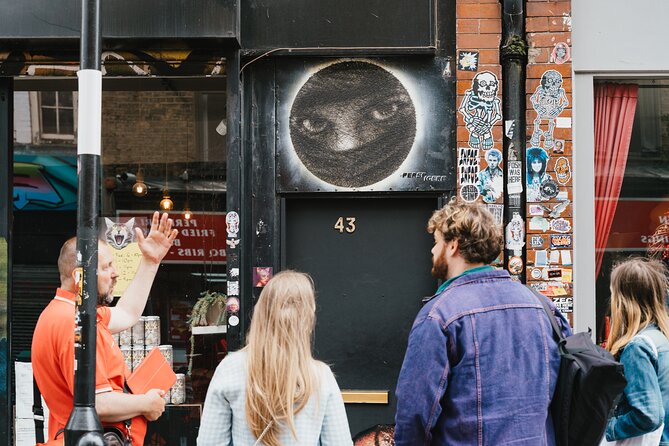
On Hanbury Street, a large bird by ROA catches your attention from a side street. Once you approach, the wall becomes much more crowded with stickers, slogans by Wrdsmth, and smaller pieces that may change often.
The main attractions are the bird and Martin Ron’s upside-down man. Both are huge, but the upside-down figure deserves close attention because it uses the existing features of the building as part of the image. The architecture is not merely a backdrop. It helps create the pose.
These works have lasted around 20 years, which is an unusually long life for street art. That fact helps you understand how temporary much of the surrounding work can be.
Broccoli Lane and the art of repetition
Dray Walk introduces one of the route’s oddest recurring images: broccoli. Some examples look fairly realistic, while others appear in bright, unexpected colors.
The artist Adrian Boswell started placing the vegetable around Brick Lane. The joke grew large enough that part of the street became known informally as Broccoli Lane. Boswell now has a gallery and sells broccoli images in frames.
It is a cheerful stop, but it also raises a useful question about repetition. When does a repeated image become a signature? When does a street joke become part of a neighborhood’s identity? The tour gives you room to consider those questions without turning the walk into a formal art lecture.
Allen’s Gardens shows graffiti in constant motion
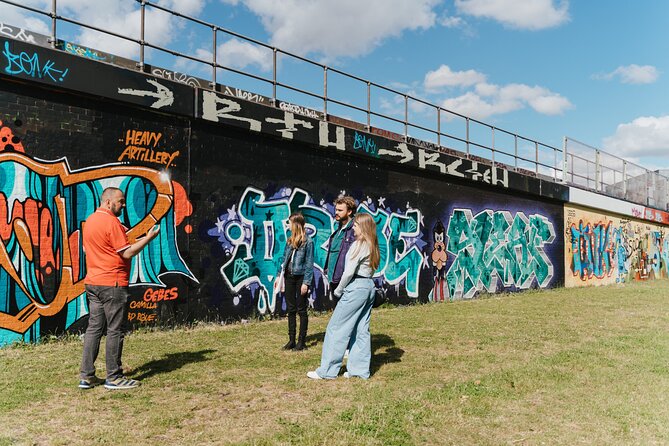
Allen’s Gardens is one of the most useful stops for understanding graffiti writing. The park is ringed by walls, and some works change every few days.
Take photographs here if you see something you like. You might not see the same image again. That sense of change is central to the experience, though it can also disappoint anyone hoping to document a fixed collection of murals.
Much of the work is made by graffiti writers who focus on letters. The lettering can be almost impossible to read. That is not a failure. For some artists, making a word difficult to decipher is part of the challenge. The result can look closer to abstract color and shape than ordinary writing.
As you leave the park via Buxton Street, look up for the number 5. The guide uses it to introduce another artist and explain how multiple artists can share one wall without producing visual chaos.
Ebor Street shifts from rough to polished
Ebor Street marks a change in mood. You leave the older, rougher feel of Brick Lane and move toward a more modern part of the district, where large painted advertisements sit beside small personal works.
Look for the pink portraits by Neon. They appear almost misted onto the wall, with spray paint placed carefully enough to form faces with character and expression. The technique is delicate compared with the heavy lettering and huge animal murals seen earlier.
A second Ebor Street stop focuses on Ben Eine. His large letters are the opposite of mysterious graffiti writing. You can read them from far away, and each letter has a clear, confident form.
Eine changes his fonts from piece to piece. Some are curved and elaborate, others sharp and modern, while some are plain blocks. It is a good reminder that lettering can be both a message and a visual object.
Banksy, glass panels, and a useful art debate
No London street-art walk would feel complete without Banksy, and this route includes a secret yard on Rivington Street where older Banksy pieces appear behind glass panels.
The glass protects the work, but it also changes the experience. You are looking at street art that has been moved toward museum treatment. Is protection necessary? Does it preserve the work or separate it from the rough setting that gave it meaning?
Those are not questions with one correct answer. The tour encourages discussion about the art market, changing tastes, and personal reactions. That makes this more useful than a simple name-spotting exercise.
Rivington Street continues with work by Otto Schade. At first, you may see only half of a soldier from one angle. Move to the corner and the full image comes into view.
Schade’s style resembles ribbons, with lines that seem empty inside but still carry energy. The guide points out how he pushes stencil work into something more intricate. This is another place where your position matters, so keep moving rather than taking one quick photograph and leaving.
Colorful faces and a preserved piece of wall
Further along Rivington Street, Thierry Noir’s colorful heads bring a lighter mood. Noir is known for painting bright characters for more than 40 years, including his important work on the Berlin Wall in the 1980s.
His London images are easy to recognize and photograph. They use strong colors and simple forms, making them especially good backdrops for portraits.
At art’otel London Hoxton, you see a different kind of street-art survival. A section of wall painted long ago by Banksy was removed from its original location and installed at the hotel.
You do not need to stay at the hotel to see it. The piece is visible from the street, which keeps it available to anyone passing by. Still, the setting invites another debate: can a removed wall remain street art once it becomes part of a polished hotel property?
Shakespeare, Romeo and Juliet, and a wall of many styles
Hewett Street adds an unexpected historical turn. A statue of William Shakespeare sits on a bench marking the former grounds of the Curtain Theatre. You can sit beside him for a photo, an amusing break from the spray paint.
Nearby, a graffiti image of Romeo and Juliet recalls the play’s early connection with this location. The pairing of Shakespeare and street art works because both are forms of public storytelling, even if they use very different tools.
At New Inn Broadway, one large building becomes a shared canvas. Several artists cover it with different colors, techniques, and ideas, including a small policeman. The result is a kind of graffiti wallpaper, where many separate works combine into one broad composition.
Graffiti Wars lead toward Liverpool Street
The final stretch takes you toward the glass and steel buildings of the City. The visual change is sharp: old brick streets and painted walls give way to modern office towers.
Before the finish, you hear the last part of the Graffiti Wars story. The subject is serious, but it also explains why certain artists and styles became so closely linked with East London.
The tour ends within walking distance of Liverpool Street Station, though the exact final point can change as the art changes. That flexibility makes sense for a street-art route. A fixed endpoint would be less useful than following the best current work.
Practical details that affect your day
This is a walking tour with free admission at every stop. The $49 price covers the guide and the chance to make your own street art, not entry to a museum or a meal.
The group can include up to 20 people. That is small enough for a narrow yard or side street, though you should not expect a private tour. Since many stops last only five minutes, stay close to the guide and be ready to move.
A mobile ticket is provided, and confirmation arrives when you book. Service animals are allowed, the route is near public transportation, and most people can participate. The tour starts at 11:00 a.m. at 80 Whitechapel High Street and finishes near Liverpool Street Station.
You can cancel for a full refund up to 24 hours before the start time. The experience needs a minimum number of people, so a cancellation by the operator may result in another date or a full refund.
Who should book this East London art walk?
I would choose this tour if you want context, artist names, and access to small side-street works that are hard to find alone. It suits photographers, first-time visitors curious about Shoreditch, and anyone interested in how art interacts with local communities.
It is also a good pick if you want a short activity that fits around other London plans. The route starts late enough for a relaxed morning and finishes near a major station.
I would think twice if you want long, quiet time at each mural. Seventeen stops in two hours means the tour favors variety over extended study. The art also changes, so the exact collection cannot remain fixed.
Should you book it?
Book this walk if you want to see East London through its walls rather than its major monuments. The strongest parts are the tucked-away Heneage Street murals, Allen’s Gardens, the Banksy discussion, and the contrast between local community art and commercial preservation.
At $49, it offers solid value for a guided introduction, especially if you would otherwise spend hours searching for the best pieces. Bring a phone or camera, wear comfortable shoes, and keep your eyes above street level. If your priority is a slow art-school tour, choose something longer. If you want a lively, focused introduction with a hands-on finish, this is a sensible choice.
FAQ
How long does the East End street-art tour last?
The tour lasts approximately two hours.
Where does the tour begin?
It begins at 80 Whitechapel High Street, London E1 7QX, UK.
What time does the tour start?
The scheduled start time is 11:00 a.m.
Where does the tour finish?
It finishes within walking distance of Liverpool Street Station. The exact endpoint may change depending on the street art available at the time.
How much does the tour cost?
The listed price is $49 per person.
Is admission to the street-art locations included?
All listed stops have free admission. The tour includes a walking tour led by a local London guide and an opportunity to make your own street art.
Will I see Banksy artwork?
Yes. The route includes older Banksy works on Rivington Street and a Banksy wall section displayed outside art’otel London Hoxton.
How many people can join the tour?
The maximum group size is 20 people.
Is the tour close to public transportation?
Yes. The route is near public transportation, and it ends within walking distance of Liverpool Street Station.
Can I cancel for a refund?
Yes. You can cancel at least 24 hours before the start time for a full refund. Cancellations or changes made less than 24 hours before the start are not accepted for a refund.
Latest arrivals on the London list
- Easy Access Tower of London Royal Secrets & Scandals Tour★ 5.0 · 3 reviews
- Stonehenge Special Access Guided Morning Tour from London★ 4.5 · 3 reviews
- Shoreditch & East London Walking Tour with a Local, Custom & Private★ 5.0 · 3 reviews
- Madame Tussauds London Fast Track and Champagne Experience★ 3.5 · 3 reviews
- London Private Brixton Tour with a Local – Culture & Stories★ 4.9 · 3 reviews
- Private Full Day Tour – Fast Track Tower of London and Lunch★ 4.6 · 3 reviews
- Private transfer from London Heathrow Airport to Southampton★ 5.0 · 3 reviews
- The women of London★ 4.5 · 3 reviews
East End & Shoreditch Tours, compared.
Gangster Tour of London’s East End Led by Actor Vas Blackwood
Read our review →
East End Street Art Tour and Spray Painting Workshop
Read our review →
PRIVATE London Food Tours – Borough Market, Soho, East End
Read our review →
Private East End Food Tour: 7 Tastings with Bagels & Fish & Chips
Read our review →

Walking Tour around Spitalfields in the East End of London
Read our review →Browse the lists this tour appears in