
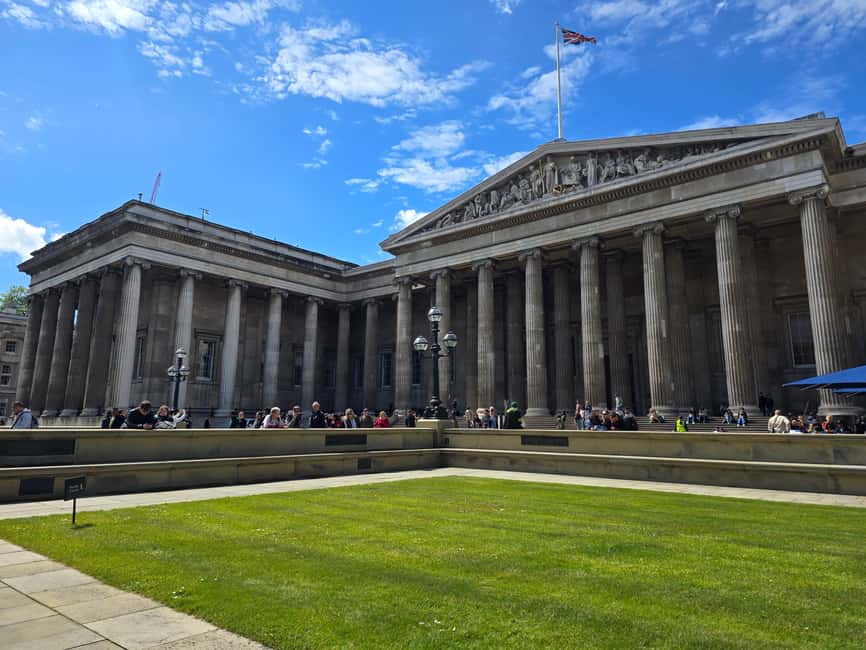
Reviewed · BRITISH MUSEUM TOURS
London: British Museum Guided Tour with Priority Entrance
The British Museum is the sort of place that can swallow a whole day before you have found half the rooms. This two-hour guided tour gives you a practical route through its greatest hits, from the Rosetta Stone and Egyptian mummies to the Parthenon Sculptures and Sutton Hoo treasures.
I like the clear commentary from guides such as Antonio, Mira, Alex, Tony, Tara, and James, and I like the use of headsets, especially in crowded galleries. The tour also gives you a useful museum overview before leaving you free to return to the rooms that catch your eye. The main drawback is simple: two hours can only introduce this enormous collection, not cover it fully.
In This Review
- Key points at a glance
- Why a two-hour route helps inside the British Museum
- Meeting your guide at 52 Great Russell Street
- The Great Court gives you a memorable first look
- Ancient Greece and the Parthenon Sculptures
- Egypt through mummies, writing, and royal power
- The Enlightenment Room and the age of collecting
- Asian art from China and Southeast Asia
- Sutton Hoo and Anglo-Saxon England
- Guides, headsets, and the feel of the group
- Is $53.87 good value?
- What the two-hour schedule really means
- Who should book this museum tour?
- Should you book it?
- FAQ
- How long is the British Museum guided tour?
- Where does the tour begin?
- What does the tour include?
- Which languages are available?
- Can I cancel the booking?
- Is the tour suitable for wheelchair users?
Key points at a glance
- Start with the Great Court: Look up at the sweeping glass roof before entering the galleries.
- See the museum’s essential objects: The route includes the Rosetta Stone, Parthenon Sculptures, Egyptian mummies, and Sutton Hoo finds.
- Get a story, not just a label: Guides connect objects to religion, politics, art, burial customs, and scientific discovery.
- Keep in touch with the guide: Headsets are available, a useful feature in busy rooms.
- Plan extra time afterward: The tour ends where it begins, so you can continue exploring on your own.
- Check the practical limits: The experience is not suitable for wheelchair users, people with mobility impairments, babies under one year, or people with hearing impairments.
Why a two-hour route helps inside the British Museum
The British Museum holds more than 8 million objects across more than 70 galleries. That number explains both its appeal and its problem. You can enter with a short list of famous pieces and still spend much of your visit simply finding the right rooms.
A guide solves that first-visit problem. Instead of wandering from gallery to gallery, you move through selected highlights with a sense of order. The tour crosses several civilizations and periods, so you get a broad introduction rather than a close study of one collection.
That approach suits you best if this is your first visit, if your London schedule is tight, or if ancient art feels hard to read without context. A label may tell you an object’s date and place. A guide can explain why it mattered, how it was used, and what it reveals about the people who made it.
The tour is conducted in English, Italian, or Chinese, depending on the selected option. Small groups are available, and the guides are encouraged to answer questions. That matters in a museum where a short question can change the pace from a standard highlights walk into a more personal conversation.
More British Museum visits:
- London: British Museum Guided Tour
★ 4.3 · 1,182 reviews - British Museum London Guided Tour Semi-Private 8ppl Max
★ 5.0 · 984 reviews - London: Tour of the British Museum
★ 4.1 · 678 reviews
Meeting your guide at 52 Great Russell Street
The listed starting point is 52 Great Russell Street, with the guide waiting inside the museum beside the information desk. This is important because the meeting point is not simply an outdoor corner where you can arrive casually and expect to spot a guide at once.
The experience includes priority tickets for the main entrance with allocated timeslots and access through a separate entrance. Follow the booking instructions closely, then allow enough time to reach the information desk. The museum can be busy, and a calm arrival is better than beginning your visit by rushing through security and searching for your group.
The tour returns to the same meeting point at the end. Transportation is not included, and neither are food or drinks, so arrange those separately. The good news is that the return to the starting place makes it easy to continue through the museum on your own.
The Great Court gives you a memorable first look
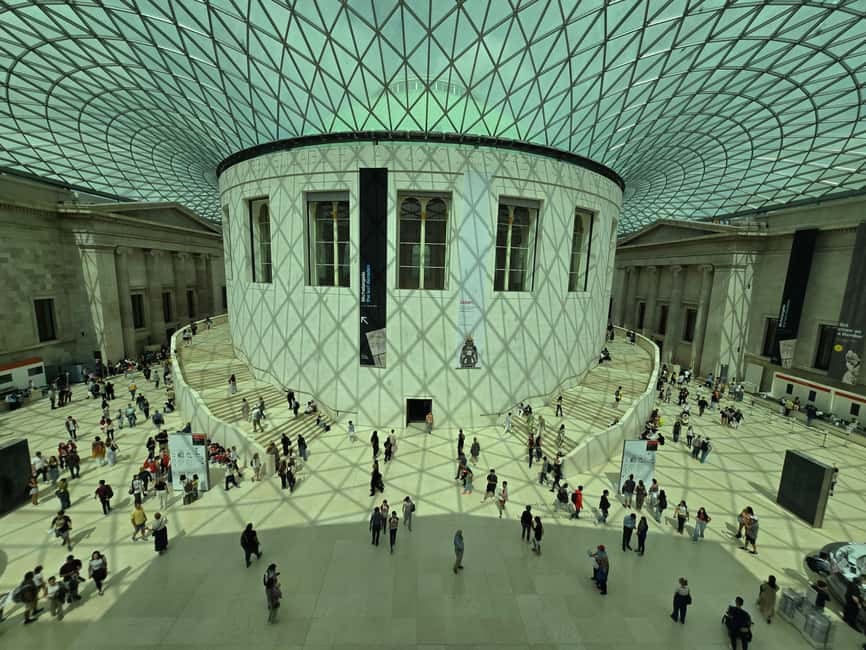
Before the tour moves into the collections, you get a view of the Great Court and its famous glass roof. This is more than a passage between galleries. The roof turns the central court into a bright, open meeting place and gives you an immediate sense of the building’s scale.
I recommend taking a moment to look upward. A guided museum tour can encourage you to keep moving, but this is one of the few times when the architecture itself deserves your full attention.
The Great Court also helps you understand the museum layout. The galleries spread around this central space, and the guide’s route gives you a useful mental map. That orientation becomes valuable later, when you return to a room you want to see at your own speed.
Ancient Greece and the Parthenon Sculptures
The Parthenon Sculptures, also called the Elgin Marbles, are among the museum’s most famous objects. The tour uses them to introduce ancient Greek art, myth, and the way sculptors represented gods, heroes, and human bodies.
You should expect a brief but focused look rather than a long academic lecture. The guide points out details and places the sculptures within the larger story of the Parthenon and classical Greece. The myths and legends give the stone figures a human setting, making them easier to remember than a collection of isolated names.
This is also a place where you may want to return after the tour. Two hours moves quickly, and the sculptures reward a second look once you know what details to seek. The tour gives you the starting tools, then lets you decide how much more time the subject deserves.
More London museums to visit:
- Tower of London and Crown Jewels Exhibition Ticket
★ 4.5 · 6,677 reviews - London: Chelsea Football Club Stadium and Museum Tour
★ 4.8 · 4,576 reviews - Chelsea FC Stadium Tours and Museum
★ 5.0 · 1,908 reviews - London Transport Museum Entrance Ticket
★ 4.5 · 1,323 reviews
Egypt through mummies, writing, and royal power
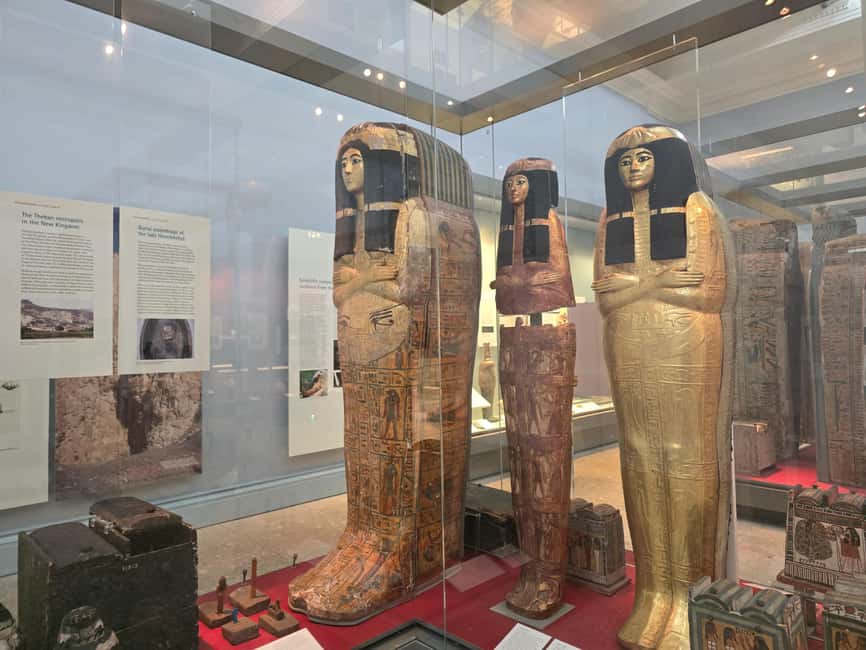
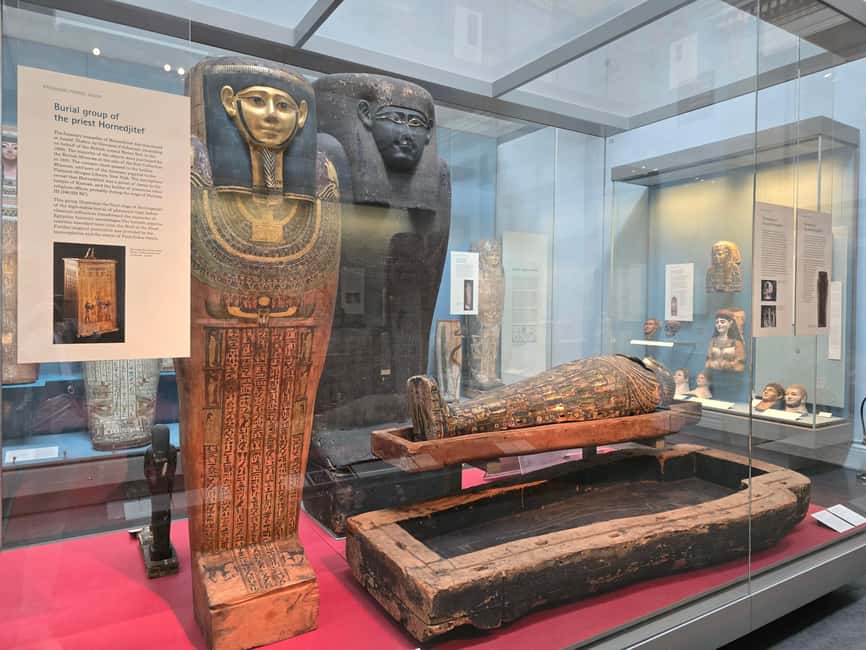
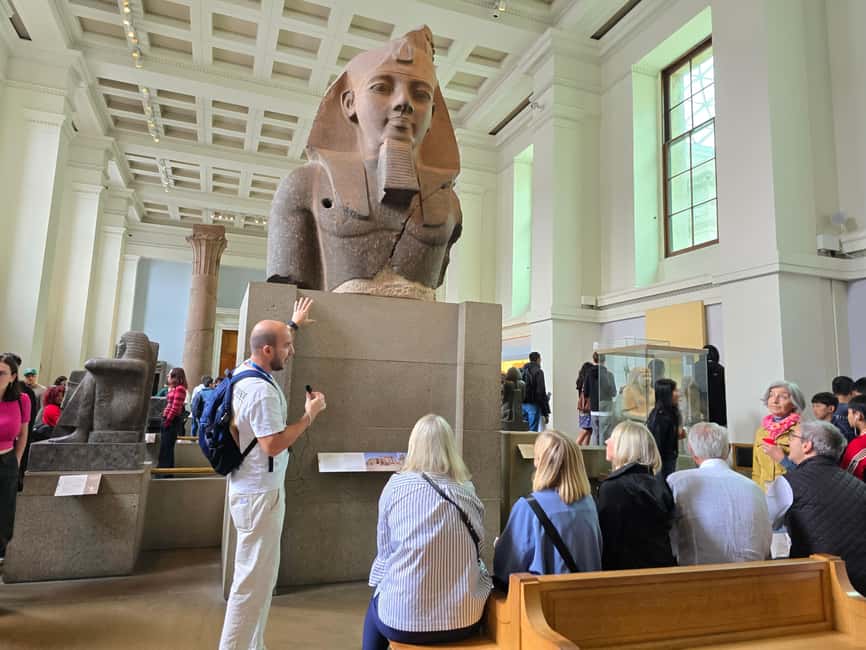
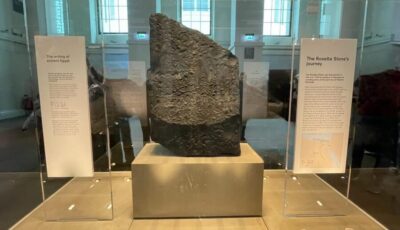
The Egyptian galleries bring together several of the tour’s strongest stops. You see mummies, the Book of the Dead, the bust of Ramesses II, and the Rosetta Stone.
The mummies offer a direct connection to burial customs and religious beliefs. Rather than treating them as spooky displays, the guide can explain the practices and ideas surrounding death, the afterlife, and the care taken to prepare the dead.
The Book of the Dead adds another layer, showing how written words and images were tied to religious practice. The bust of Ramesses II shifts the focus toward royal power and representation. Together, these objects give you more than a parade of old things. They show how writing, faith, politics, and art worked together in ancient Egypt.
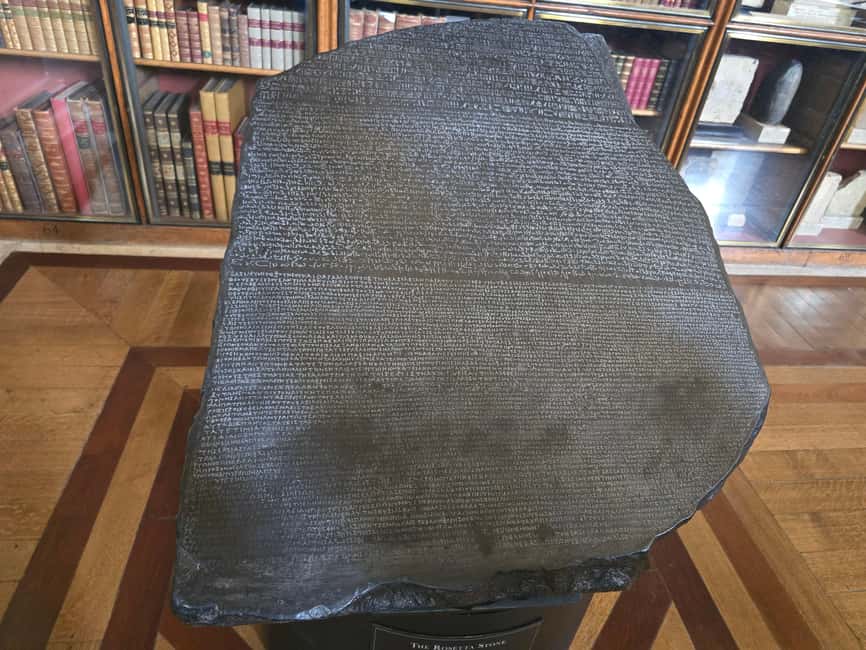
The Rosetta Stone is the practical star of this section. Its importance comes from the role it played in understanding Egyptian hieroglyphs. Guides with a particular interest in hieroglyphics, including the guides praised for their explanations on this route, can make the stone easier to appreciate without turning the stop into a technical lesson.
The Egyptian rooms are popular, so this is where the headset can earn its keep. You can stay close to the guide while still hearing the explanation clearly, even when other groups are nearby.
The Enlightenment Room and the age of collecting
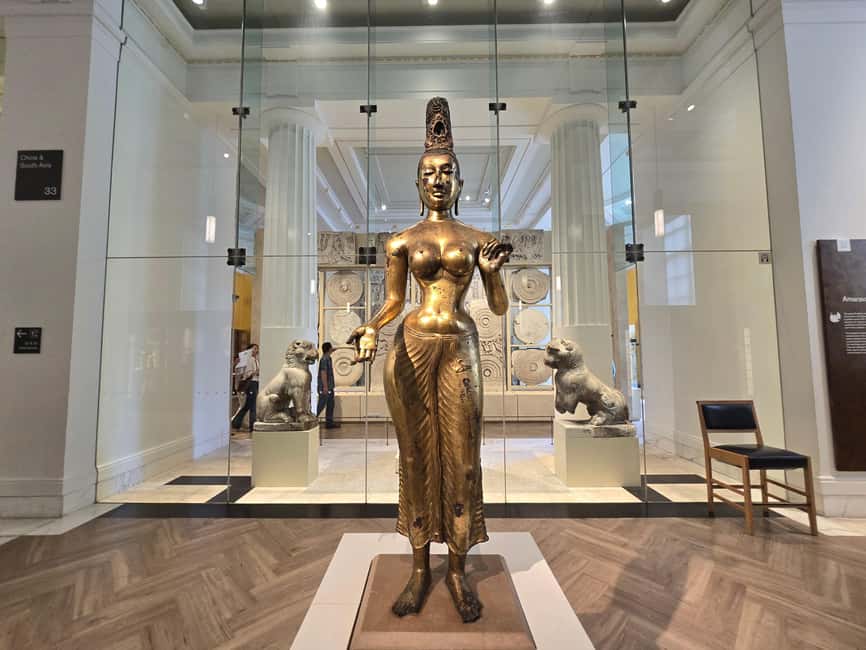
The Enlightenment Room offers a change of mood. After ancient Greece and Egypt, you move into the intellectual world of the 18th century, with objects linked to science, learning, collecting, and the effort to classify human knowledge.
This room helps explain why a museum like the British Museum took shape. The objects reflect curiosity about the natural world and the cultures of distant places. A guide can connect the displays to the period’s appetite for discovery while also showing how people in that era tried to organize what they knew.
For you, this stop is useful because it widens the tour beyond the most famous sculptures and mummies. It asks how museums collect, arrange, and present knowledge. That makes the visit feel less like a greatest-hits album and more like a walk through changing ideas.
Asian art from China and Southeast Asia
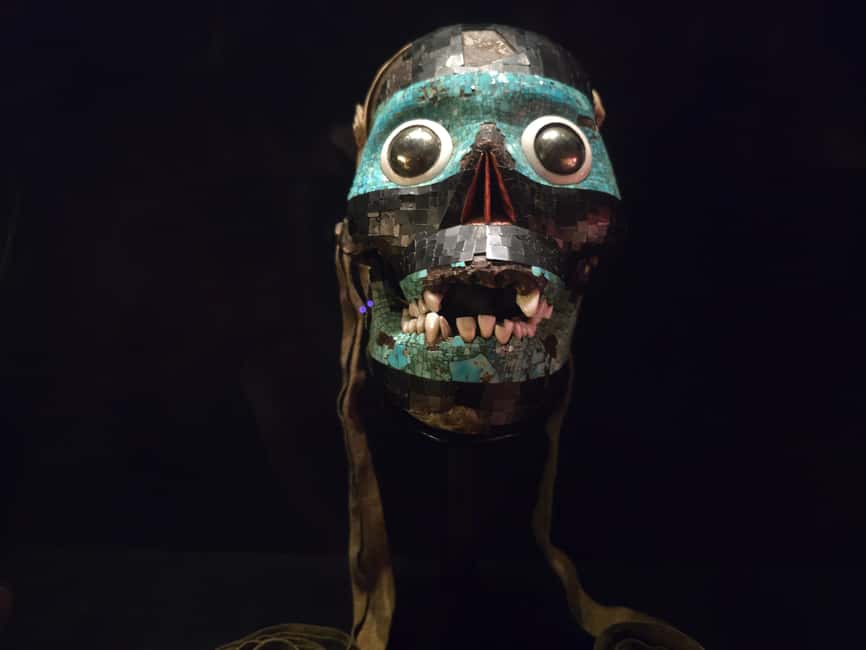
The route also includes the Chinese collection and crafted objects from Southeast Asia. These galleries give the tour a wider geographical balance and prevent the visit from focusing only on Europe and Egypt.
You’ll encounter artistic traditions shaped by different beliefs, materials, courts, religions, and daily customs. The exact objects discussed can depend on the guide and the gallery route, but the aim is to show the range of the museum’s Asian collections and the skill behind the objects.
This part may feel fast if you are especially interested in Asian art. That is one of the tradeoffs of a highlights tour. You get an introduction and a few memorable examples, then you can return afterward for a slower look.
The guides’ ability to move between continents is one of the useful features of the experience. Mira and Alex, for example, were praised for covering major objects from different countries while keeping the group moving. That broad range is hard to achieve alone if you do not already know the museum.
Sutton Hoo and Anglo-Saxon England
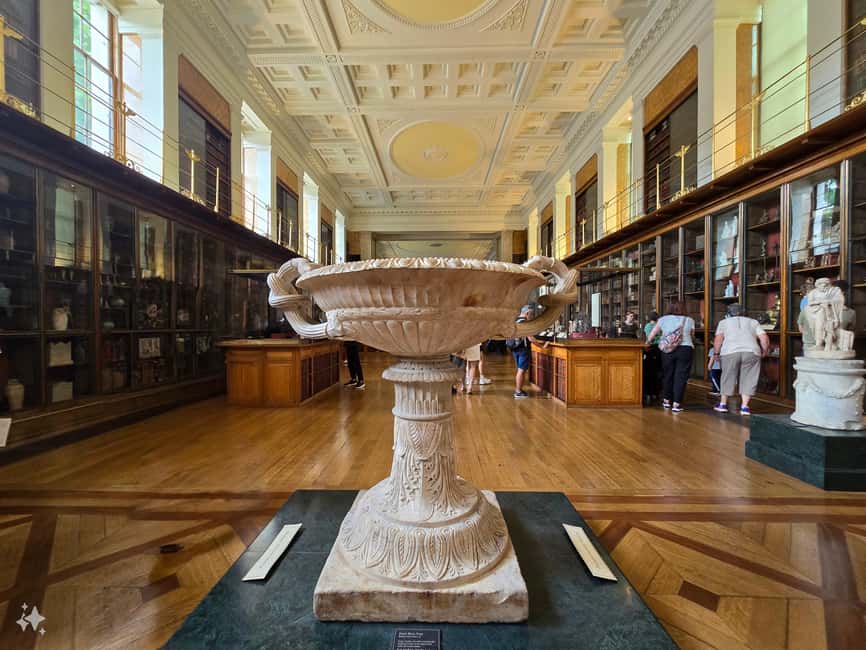
The Sutton Hoo ship burial provides the tour’s main window into Anglo-Saxon England. The helmet, shield, and other objects reveal the craftsmanship, status, and burial customs of early medieval England.
The helmet is especially effective as a museum stop because it is both visually striking and tied to a larger story. The guide can explain how the objects were found together and what they suggest about the society that created and buried them.
This section also brings the British Museum closer to home for a London visit. After seeing Egypt, Greece, China, and Southeast Asia, you return to the history of the British Isles. That contrast helps you see the museum as a collection of connected human stories rather than separate rooms.
Guides, headsets, and the feel of the group
The guide is the heart of this experience. Names associated with the tour include Antonio, Mira, Alex, Tony, Tara, James, and others. The strongest descriptions of their work point to clear organization, humor, good timing, and a willingness to answer questions.
Antonio is noted for placing objects in a wider world-history setting. Mira and Alex are praised for keeping track of the group, checking that nobody is lost, and adjusting the route when needed. Tara is described as lively and well informed, while Tony is remembered for creating a strong first introduction to the museum.
That range matters because a museum tour can become tiring if it is only a stream of dates and object names. The best guides on this experience use stories, myths, and small details to keep the pace human. You are still learning, but you are not expected to memorize a textbook.
Headsets are available, and the experience description says they are provided. Since the wording about headset availability can vary by booking option, I would confirm the exact arrangement when reserving. In a crowded museum, clear audio is not a luxury. It lets you look at the object instead of leaning toward the guide and missing the explanation.
Group size also affects the feel of the tour. A small group is available, and an unusually quiet departure may become almost private. One booking turned into a solo tour, allowing a question-and-answer conversation with Antonio. You should not count on that happening, but the example shows why group size can change the experience.
Is $53.87 good value?
At $53.87 per person, this is not the cheapest way to enter the British Museum. The museum itself is known for free general admission, though special arrangements, timed access, and guided services can change the cost of a particular visit.
You are paying mainly for three things: a planned route, a live guide, and priority entrance arrangements. The value is strongest if you want a smart introduction and would otherwise spend time finding the famous rooms yourself. It is also useful if you have only a morning or afternoon in London.
The value is weaker if you prefer to read every label, spend an hour with one object, or wander without a fixed pace. You might get more from free admission and a self-guided plan if you already know the museum well.
For a first visit, I see the price as a payment for orientation and saved time. The tour shows you what matters to many first-time visitors, then leaves you in a better position to choose your own next gallery.
What the two-hour schedule really means
The advertised duration is two hours, but that does not mean you will see everything worth seeing. The British Museum is far too large for that. Think of the tour as a structured introduction to several major collections.
The pace is likely to be steady, with stops long enough for explanation and questions. You will move between galleries, listen through the headset, and keep track of the guide in a busy setting. Comfortable shoes and a little patience will help, though no extra preparation is required from the information provided.
At the end, you can continue exploring from the meeting point. I would protect at least another hour if your schedule allows, especially if the Egyptian galleries, Sutton Hoo, or Asian collections interest you. The tour’s greatest practical benefit is that it tells you where to spend that extra time.
Who should book this museum tour?
I would recommend it most strongly to first-time visitors, short-stay visitors, families with older children, and anyone who wants a broad introduction without spending a full day inside. It also suits people who enjoy asking questions and learning through stories rather than reading every display label alone.
The language options make it useful for English, Italian, and Chinese speakers, subject to the selected departure. Small groups are available, which should appeal to anyone who wants a more personal exchange with the guide.
This is not the right choice for a slow, specialist study of one collection. It is also not suitable for wheelchair users or people with mobility impairments, babies under one year, or people with hearing impairments. Flash photography is not allowed.
Free cancellation up to 24 hours before the activity gives you some flexibility, and you can reserve now and pay later. Those terms are useful when your London plans are still shifting, but check the booking details for your chosen time and language.
Should you book it?
Book this tour if you want the British Museum’s major stories in a clear order, with a live guide to explain why the Rosetta Stone, Parthenon Sculptures, Egyptian mummies, and Sutton Hoo treasures matter. The combination of priority entry, headsets, and a two-hour route is especially practical for a first visit.
Skip it if you already know the museum well or want to set your own pace from the first room to the last. For most first-time visitors with limited London time, though, this is a sensible way to get your bearings fast, see the essential objects, and still have time to explore on your own.
FAQ
How long is the British Museum guided tour?
The guided tour lasts two hours. After it ends, you can continue exploring the museum independently from the meeting point.
Where does the tour begin?
The guide waits inside the British Museum beside the information desk. The listed starting location is 52 Great Russell Street.
What does the tour include?
It includes a guided British Museum tour with commentary, priority tickets for the main entrance with allocated timeslots, and access through a separate entrance. Headsets are available, with the experience information also describing them as provided.
Which languages are available?
Live guiding is listed in English, Italian, and Chinese. The included commentary is listed as English or Italian, so confirm the language option when booking.
Can I cancel the booking?
You can cancel up to 24 hours before the activity for a full refund. Reserve now and pay later is also available.
Is the tour suitable for wheelchair users?
No. The experience is listed as unsuitable for wheelchair users and people with mobility impairments. It is also not suitable for babies under one year or people with hearing impairments.
Latest arrivals on the London list
- Heathrow Airport to London Arrival Transfer★ 4.5 · 50 reviews
- London Beatles Tour★ 5.0 · 50 reviews
- One Way Taxi Transfer from London to Gatwick Airport★ 5.0 · 51 reviews
- City & Secrets: Explore London’s Hidden Gems★ 5.0 · 51 reviews
- London: Hidden Baker Street Tube Station Tour★ 4.7 · 51 reviews
- London Christmas Lights Open-Top Bus Tour. 2025 Early Bird★ 3.6 · 51 reviews
- 4 hour London Private Tour, with your own Black Cab Tour Guide★ 5.0 · 51 reviews
- The Beatles Magical History Black Taxi Tour London★ 5.0 · 51 reviews
British Museum Tours, compared.

British Museum London Guided Tour Semi-Private 8ppl Max
Read our review →
British Museum Audio Tour & Priority Entrance Ticket
Read our review →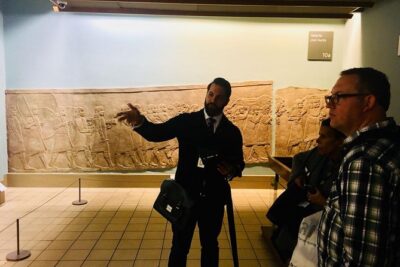
The British Museum London – Exclusive Guided Museum Tour
Read our review →

Browse the lists this tour appears in