
Reviewed · BRITISH MUSEUM TOURS
Explore Biblical Artifacts at the British Museum
The most unusual thing about this British Museum experience is its clear purpose: David leads you from ancient Egyptian, Assyrian, Greek, and Roman objects back to specific Bible stories and passages. Instead of wandering through hundreds of rooms, you follow a timeline that connects Joseph, Moses, Jonah, Hezekiah, Jesus, and Paul to the world around them.
I like the small group of no more than 10 and the practical study material, including a Google Doc with notes and Bible verses. I also like the folding stools. Three or four hours on museum floors is a long stretch, and sitting when you need to makes this much easier.
The main consideration is focus. This is not a general British Museum highlights tour or a neutral survey of every major collection. It is a Bible-centered reading of selected objects, so it suits you best if Scripture and ancient religious history are central to your interests. The museum can also feel warm in places, and the tour is not a good first-day activity if you have just landed from a long-haul flight.
In This Review
- Key points to know before you book
- Why this British Museum tour feels different
- Starting with Assyria, Egypt, and Greece
- Roman galleries, Jesus, Paul, and the New Testament world
- Optional Persia and Babylon galleries
- How the Bible study material helps
- Price, timing, and what the $77.50 covers
- Who will enjoy it most
- Practical advice for a better visit
- Should you book David’s British Museum tour?
- FAQ
- Where does the tour begin and end?
- How long does the experience last?
- How much does the tour cost?
- How many people can join?
- What language is the tour offered in?
- Which museum galleries are included?
- Should I bring a Bible?
- Can I cancel for a full refund?
Key points to know before you book
- David builds a Bible timeline: He links rulers, empires, prophets, Jesus, and Paul in a clear sequence.
- The tour begins downstairs: Expect Assyrian, Egyptian, and Greek galleries before moving upstairs to Roman rooms.
- Major objects anchor the stories: You’ll see lamassu, pharaoh statues, Parthenon sculptures, Roman emperors, and coins from the time of Jesus.
- A Google Doc adds value: Study notes and related Bible verses help you prepare and continue reading afterward.
- Folding stools are available: You can take one along, a useful aid on hard museum floors.
- The price buys guidance, not admission: Museum entry is free, while the $77.50 fee pays for David’s teaching and route through the collection.
Why this British Museum tour feels different
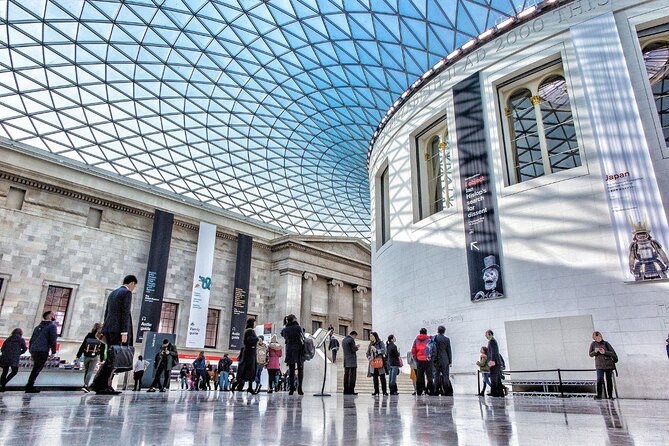
The British Museum can be a wonderful place to get lost, but getting lost is also the problem. Its collection covers thousands of years, and a first visit can become a march past labels with little sense of how the pieces fit together.
This tour gives you a framework. David uses objects as markers on a larger biblical timeline, moving between the cultures that shaped the Old and New Testament world. You are not simply shown a statue and told its date. You are asked to consider the people, rulers, conflicts, and customs connected with it.
That approach is especially useful if you already know Bible stories but have trouble placing them in time. Names such as Assyria, Babylon, Persia, Greece, and Rome can blur together when read on a page. Here, the galleries give those powers a physical setting.
David’s teaching style is a major part of the experience. He is described as funny, clear, energetic, and passionate about both Scripture and museum objects. He also takes questions, points out small details, and adjusts the route when a gallery is due to close early.
The result is closer to a guided Bible study in a museum than a standard sightseeing walk. You should expect a lot of explanation, links between passages, and frequent attention to details that are easy to miss on your own.
More British Museum visits:
- London: British Museum Guided Tour
★ 4.3 · 1,182 reviews - British Museum London Guided Tour Semi-Private 8ppl Max
★ 5.0 · 984 reviews - London: Tour of the British Museum
★ 4.1 · 678 reviews
Starting with Assyria, Egypt, and Greece
The first part takes place on the ground floor, in the Assyrian, Egyptian, and Greek galleries. This is a strong opening because it puts scale and power in front of you right away.
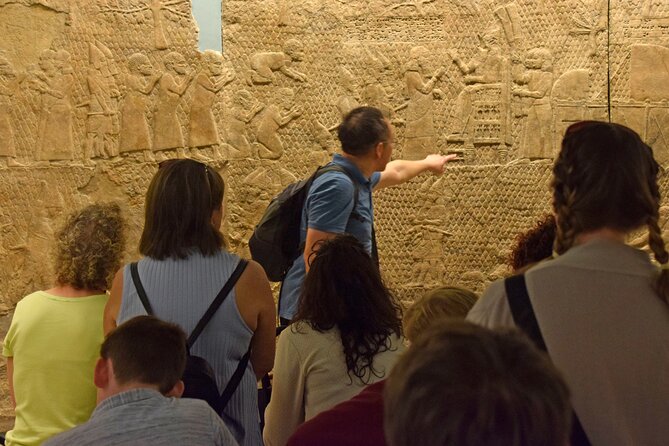
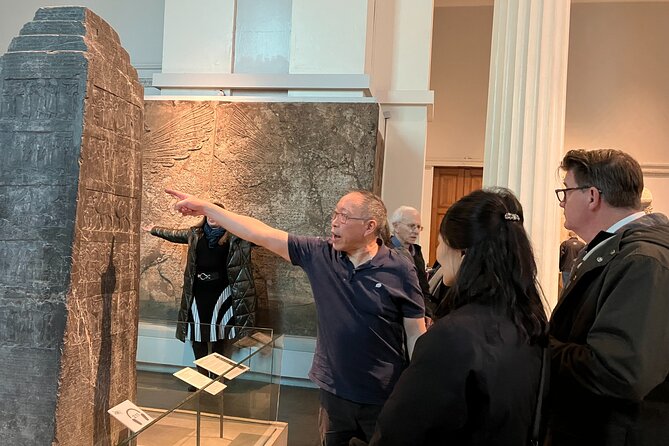
The Assyrian lamassu are among the most memorable objects on the route. These enormous human-headed, winged bulls weigh about 40 tons. Their size helps explain the confidence and force of the Assyrian empire far better than a paragraph in a book.
From there, the discussion turns to Assyrian rulers and their contact with Israel and Judah. Biblical figures connected with this section include Jonah, Ahab, and Hezekiah. David uses the objects and inscriptions as points of reference while connecting them with relevant passages.
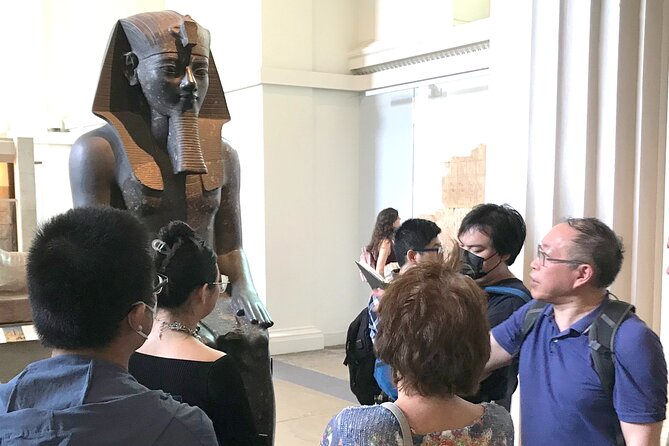
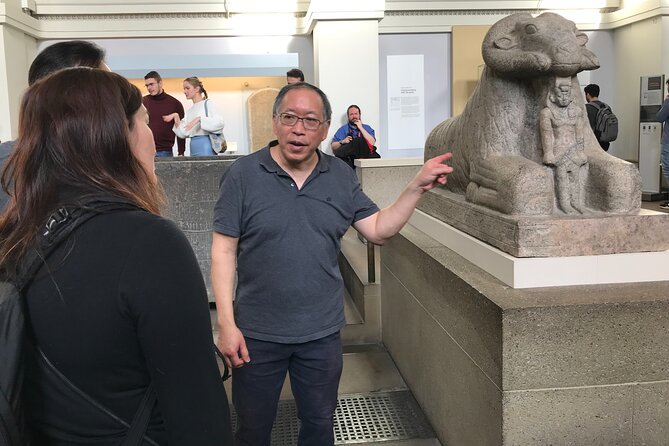
The Egyptian galleries bring Joseph and Moses into the conversation. You will see statues of famous pharaohs and other objects from the civilization that shaped the early biblical story. The value here is not that every displayed item can be tied to one named Bible character. Rather, the galleries provide a setting for thinking about Egyptian power, royal imagery, and the world in which those stories unfold.
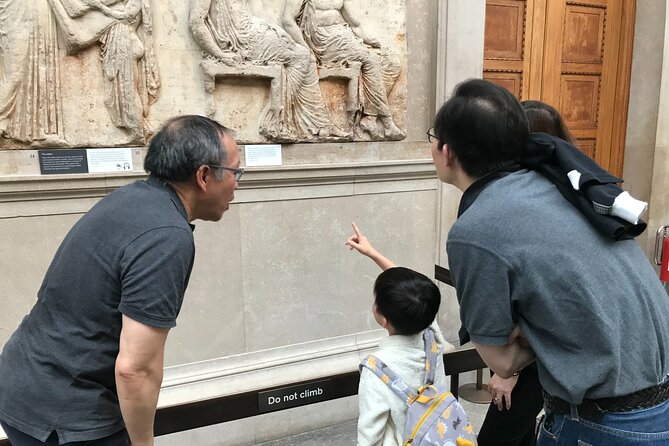
The Greek rooms add another layer. Paul’s connection with the Greek world becomes easier to picture when you are standing among Greek sculpture and architectural remains. The Parthenon sculptures from Athens are an obvious highlight, though the tour’s purpose is not simply to admire famous art. David uses the Greek material to help explain the cultural world through which Christianity later spread.
The route involves plenty of looking up, listening, and shifting from one object to another. The optional stools matter here. If your legs, back, or feet tire easily, take one at the beginning rather than waiting until you are uncomfortable.
Roman galleries, Jesus, Paul, and the New Testament world
After a break, the group goes upstairs to the Roman galleries. This change of period brings the tour closer to the New Testament and to the political system behind the lives of Jesus and Paul.
Roman emperors become more than marble portraits. They represent the authority, administration, and public image of the empire that ruled Judea and shaped Paul’s journeys. You will also look at objects linked directly to Jesus and Paul.
One especially memorable detail from the tour is the chance to see Roman coins bearing the faces of leaders who were present during the period of the crucifixion. A coin is a small object, but it can make an abstract political setting feel immediate. You can look at the ruler’s image while considering the Roman power named in the Gospel accounts.
Paul’s connection to both Rome and Greece gives David a natural way to connect the earlier galleries with the New Testament rooms. The tour is not confined to a single culture. It shows how the biblical world changed as control moved through Egyptian, Assyrian, Babylonian, Persian, Greek, and Roman hands.
The sequence also helps you understand why a chronological route matters. A statue in one gallery may seem unrelated to a Roman coin in another. With David’s running explanation, the objects become part of a longer story about kingdoms, exile, return, occupation, and the spread of Christian teaching.
The pace can be flexible. One small group stayed close to five hours because of questions and extra discussion, even though the usual plan is about three to four hours. Do not assume every outing will last that long, but leave some breathing room in your schedule.
Optional Persia and Babylon galleries
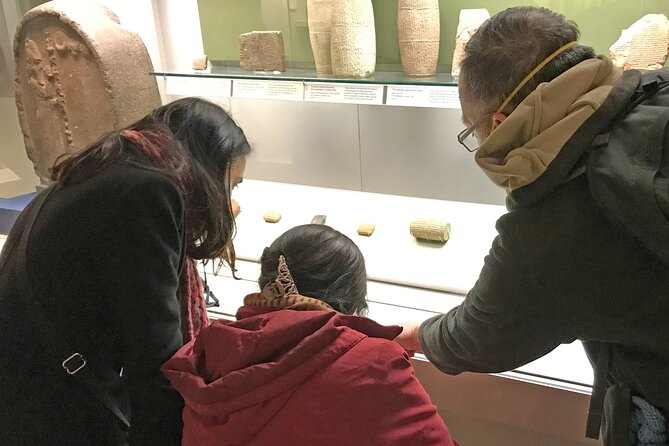
Persia and Babylon may be included when time and group preference allow. This is a useful feature because these collections fill in an important part of the Old Testament setting.
The precise route can change. Gallery schedules, closing times, and the interests of your group may affect what David includes. He has also adjusted the order when a room was due to close early, so the experience is not a rigid march through a fixed list.
That flexibility works in your favor if you enjoy questions and discussion. It may be less ideal if you want every planned room covered at exactly the same depth. If Babylonian or Persian material is your main reason for booking, ask about the likely route after you meet.
The additional rooms also reinforce one of the tour’s best ideas: Bible events did not take place in isolation. They were shaped by large empires with their own art, court customs, armies, and royal symbols.
More London museums to visit:
- Tower of London and Crown Jewels Exhibition Ticket
★ 4.5 · 6,677 reviews - London: Chelsea Football Club Stadium and Museum Tour
★ 4.8 · 4,576 reviews - Chelsea FC Stadium Tours and Museum
★ 5.0 · 1,908 reviews - London Transport Museum Entrance Ticket
★ 4.5 · 1,323 reviews
How the Bible study material helps
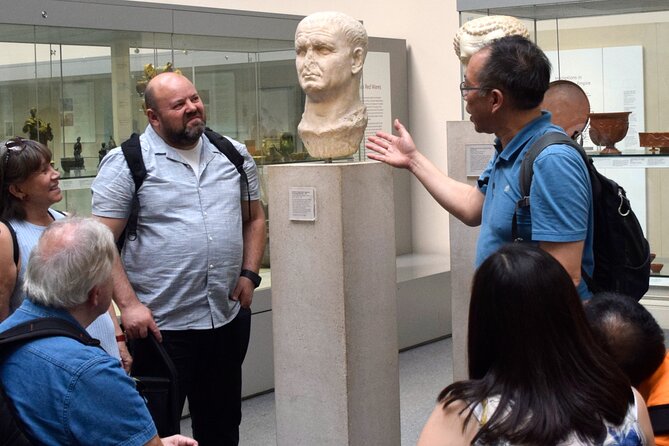
After booking, you receive access to a Google Doc filled with study notes and related Bible verses. I would read at least some of it before arriving. The notes give you names and passages to recognize, which means you can spend more of the tour looking at objects instead of trying to recall every detail.
You are also encouraged to have a Bible app that works in airplane mode. YouVersion is suggested as one option. That matters inside a large museum, where phone service may not be dependable and repeated Bible references are part of the teaching method.
David may ask you to look up a passage as you move to a related object. This turns the tour into an active session rather than a one-way lecture. You can follow the text, examine the artifact, and consider the connection at the same time.
The preparation also has value after the museum visit. The study document remains useful when you want to revisit a king, empire, or passage later. Additional follow-up information may also be sent after the tour, including clarification on topics raised during the visit.
This is one of the strongest reasons to book with a group that wants more than a pleasant afternoon indoors. The material gives you something to continue with once you leave London.
Price, timing, and what the $77.50 covers
The price is $77.50 per person, while admission to the British Museum itself is free. That means the fee is entirely for the guided experience, teaching, planning, and small-group access.
Is it good value? For a person who wants the Bible connected to museum objects, I think the answer can be yes. David knows the museum layout, brings together multiple periods, and supplies a study structure that would take considerable time to build yourself.
If you only want to see the British Museum’s famous pieces, you can enter without paying for a tour and explore at your own pace. You may also prefer a general art or ancient civilization tour if your interests are broad.
The value improves if you prepare with the Google Doc and use the Bible app during the visit. It drops if you are not interested in biblical interpretation, or if you mainly want quiet time with the collection.
Plan on a half day. The advertised length is about three to four hours, though questions and group interest can extend the visit. Leave the rest of the day open for another part of London, but do not schedule a tight appointment immediately afterward.
The tour is offered in English, includes a mobile ticket, and group discounts are available. The British Museum is near public transportation, and the activity begins and ends at the museum meeting point on Great Russell Street.
Who will enjoy it most
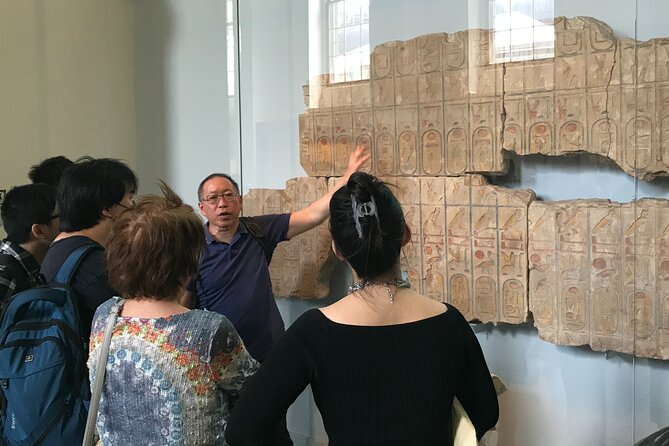
This is a natural fit for you if you enjoy the Bible, archaeology, ancient empires, or the way objects can add detail to familiar stories. It also works well for families with older children and teenagers, provided they can handle several hours of listening and walking through galleries.
The tour can suit Christian visitors who want their Bible reading placed against physical objects and historical settings. It can also suit a curious non-Christian or skeptic who wants to understand how biblical events are interpreted through the museum’s ancient collections.
The experience is less suitable if you want a fast list of highlights, a purely secular art history lecture, or a free-form museum visit. The Bible is not a side theme here. It is the organizing idea.
Older adults may appreciate the stools and the small group. Still, this remains a long museum session, so use the seating option and the break wisely. The availability of service animals and the fact that most people can participate are helpful, but the supplied details do not promise a fully step-free or specialized-access route.
Do not book it for the morning after a long flight if you are badly jet-lagged. The steady concentration required is part of the appeal, but it also makes tiredness more noticeable.
Practical advice for a better visit
Read the study notes before you arrive, even if you only have time for the main names and passages. Install the relevant apps and check your email and booking app for messages, since meeting instructions and other useful information may be sent there.
Bring a Bible app set up for offline use. You do not need to rely on a paper Bible, and an offline app makes it easier to follow the passages David references.
Arrive ready for a museum floor rather than a seated classroom. Folding stools are available inside the museum, and taking one along can make the long route much more comfortable.
Keep your schedule loose. The planned time is three to four hours, but a small group with many questions may continue longer. A break is included, and the tour ends back at the starting point.
The experience has a maximum of 10 participants. That is small enough for questions and direct conversation, while still being a group tour rather than a private visit.
Free cancellation is available if you cancel at least 24 hours before the start time. Changes or cancellations inside that window are not accepted for a refund, and the cut-off follows London local time.
Should you book David’s British Museum tour?
Book it if you want ancient objects to serve as doorways into Bible passages, and if you enjoy a guide who teaches with energy, humor, and strong personal commitment. David’s ability to link rulers, artifacts, names, and verses is the central reason to pay for this experience.
I would especially recommend it to first-time British Museum visitors who might otherwise feel overwhelmed, and to families with older children who need a clear story to hold their attention. The stools, study notes, small group, and flexible route are practical bonuses.
Skip it if you want a general museum orientation or if biblical interpretation is not your interest. You can visit the museum for free and choose your own rooms.
For the right audience, this is a thoughtful half-day addition to a London trip. You leave with more than a list of objects. You have a timeline, passages to reread, and a clearer sense of how the ancient cultures in the galleries connect with the Bible.
FAQ
Where does the tour begin and end?
It begins at the British Museum, Great Russell Street, London WC1B 3DG, and ends back at the meeting point.
How long does the experience last?
The planned duration is approximately three to four hours. One outing continued close to five hours because of questions and extended discussion, so you should leave extra time if your schedule allows.
How much does the tour cost?
The price is $77.50 per person. Admission to the British Museum is free, so the price covers the guided tour and related material rather than museum entry.
How many people can join?
The maximum group size is 10 travelers.
What language is the tour offered in?
The tour is offered in English.
Which museum galleries are included?
The route begins with the Assyrian, Egyptian, and Greek galleries on the ground floor, then continues to the Roman galleries upstairs. Persia and Babylon may be included if time and group preference allow.
Should I bring a Bible?
A Bible app that works in airplane mode is recommended. YouVersion is given as a suitable option, and you may use it to follow verses during the tour.
Can I cancel for a full refund?
Yes, if you cancel at least 24 hours before the experience begins. Cancellations or changes made less than 24 hours before the start time are not accepted for a refund.
Latest arrivals on the London list
- Heathrow Airport to London Arrival Transfer★ 4.5 · 50 reviews
- London Beatles Tour★ 5.0 · 50 reviews
- One Way Taxi Transfer from London to Gatwick Airport★ 5.0 · 51 reviews
- London: Hidden Baker Street Tube Station Tour★ 4.7 · 51 reviews
- City & Secrets: Explore London’s Hidden Gems★ 5.0 · 51 reviews
- London Christmas Lights Open-Top Bus Tour. 2025 Early Bird★ 3.6 · 51 reviews
- 4 hour London Private Tour, with your own Black Cab Tour Guide★ 5.0 · 51 reviews
- The Beatles Magical History Black Taxi Tour London★ 5.0 · 51 reviews
British Museum Tours, compared.
British Museum London Guided Tour Semi-Private 8ppl Max
Read our review →
British Museum Audio Tour & Priority Entrance Ticket
Read our review →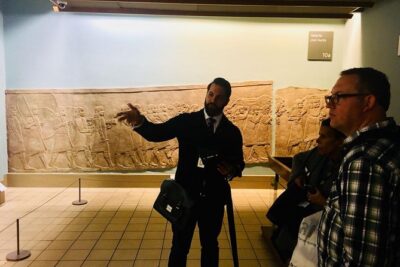
The British Museum London – Exclusive Guided Museum Tour
Read our review →
Browse the lists this tour appears in